The Paper Chase
This recording is not on YouTube. It plays from the DEF CON media server; the button opens the file there.
Where
Voting Village
DEF CON 34
Duration
49 min
Traces how a 2003 California investigation and a failed 2004 primary pushed the state to require paper records and source code review for voting machines.
Summary
The keynote opens with the push toward touchscreen voting after the 2000 Florida recount and the Help America Vote Act. Stanford computer scientist David Dill warned that direct-recording electronic machines left no independent record of each ballot, so errors or manipulation could never be detected. Former California Secretary of State Kevin Shelley describes how he first resisted that argument, then formed a task force in which only three of eleven members backed a voter-verified paper trail.
The middle covers the fallout. Bev Harris found Diebold source code and release notes on a public server, and a state audit showed 17 counties running software that had never been certified. Shelley ordered source disclosure, paper ballots and parallel monitoring, then descertified the TSX in four counties. Machines failed in Alameda and San Diego during the March 2004 primary, and a San Diego absentee miscount was caught only because paper ballots allowed a hand recount.
The closing section notes gains: California required voter-verifiable paper records by 2006, most recent presidential votes were cast on paper, and all 50 states now have post-election audit laws. Federal certification still does not require source code review, vendors still pay the test labs, and major manufacturers have not taken part in the village. The practical takeaway is that a record the voter can check matters more than a receipt.
Materials
Related talks

Voting Village·22 min
Michael Specter
Presents a study of usability failures in election administration, based on interviews and a survey of election officials.
Voting Village·46 min
Barbara Simons
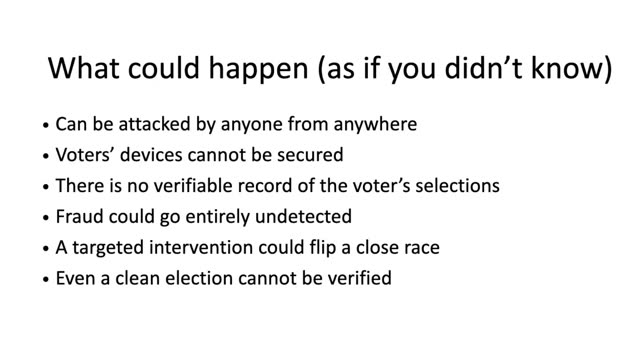
Makes the case that internet voting cannot be secured or verified, using past pilot breaches, failed trials and expert reviews as evidence.
Voting Village·26 min
Richard DeMillo
Argues that election security failures persist when known vulnerabilities become normalized, drawing on the Challenger and Columbia investigations and a Georgia voting lawsuit.