Beyond Casting and Tallying Security for the Rest of - Elections
This recording is not on YouTube. It plays from the DEF CON media server; the button opens the file there.
Where
Voting Village
DEF CON 34
Duration
22 min
Presents a study of usability failures in election administration, based on interviews and a survey of election officials.
Summary
The talk opens with the 2020 Georgia election, where long lines were blamed partly on voting cards that only worked in one orientation. The speaker argues that research has focused on casting and tallying votes, while the administrative systems around them, such as poll books, voter registration databases, ballot scanners and night-of reporting, get little study. Usability problems in those systems could matter for election integrity, so the question is how common they are and how officials cope.
To find out, the team trained as poll watchers and took poll worker training, then ran about 14 semi-structured interviews and a survey that produced 45 usable responses. Recordings were deleted after analysis under institutional review board and federal protections, so no respondent can be identified. About 73% of officials reported preventable mistakes, and roughly one in five believed usability failures could change final counts. One example involved a poll book that blocked an eligible voter, where the manager cancelled instead of proceeding, leaving a vote with no matching check-in record. Officials also described hardware faults, rural connectivity gaps, undocumented procedures, and peer-shared documentation, along with harassment and exhaustion.
The speaker closes by arguing that usability failures should be handled like vulnerabilities and that non-voter-facing election technology needs independent study. Other recommendations include legal protection for election workers, blameless postmortems, and anonymous reporting of equipment malfunctions. The findings were preliminary, and the paper was not yet public, so the team asked election officials for feedback before release.
Materials
Related talks
Voting Village·49 min
Kevin Shelley
Traces how a 2003 California investigation and a failed 2004 primary pushed the state to require paper records and source code review for voting machines.
Voting Village·46 min
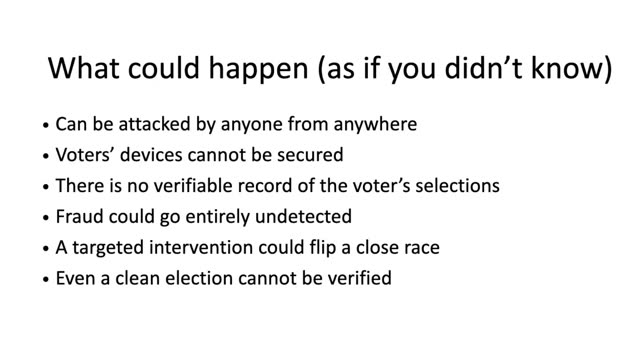
Barbara Simons
Makes the case that internet voting cannot be secured or verified, using past pilot breaches, failed trials and expert reviews as evidence.
Voting Village·26 min
Richard DeMillo
Argues that election security failures persist when known vulnerabilities become normalized, drawing on the Challenger and Columbia investigations and a Georgia voting lawsuit.