Anomalies Are Not Normal
This recording is not on YouTube. It plays from the DEF CON media server; the button opens the file there.
Where
Voting Village
DEF CON 34
Duration
26 min
Argues that election security failures persist when known vulnerabilities become normalized, drawing on the Challenger and Columbia investigations and a Georgia voting lawsuit.
Summary
The talk opens with Curling v. Raffensperger, the Georgia lawsuit over Dominion ballot-marking devices. The plaintiffs presented many vulnerabilities that both sides' experts validated, yet the judge dismissed the case in 2025 because no one could demonstrate concrete harm. The speaker frames this as a failure of institutional decision-making rather than a failure of technical discovery.
To explain the gap, the talk recalls the Challenger investigation, where a demonstration with an O-ring in ice water made the cold-weather risk concrete, and the later Columbia loss, which the review traced to normalization of deviance: repeated anomalies accepted because schedules and operations took priority. The speaker maps foam strikes onto election flaws. A state-commissioned MITRE report labeled several issues as potential loss-of-vehicle events, but officials still treated the elections as successful and the issues as irrelevant.
The takeaway for researchers and program managers is to stop treating each bug as a standalone finding and to build a theory of risk that refuses to accept known deviations. The speaker argues that election security is a canary for other civic software, so the same pattern is likely to recur there.
Materials
Related talks
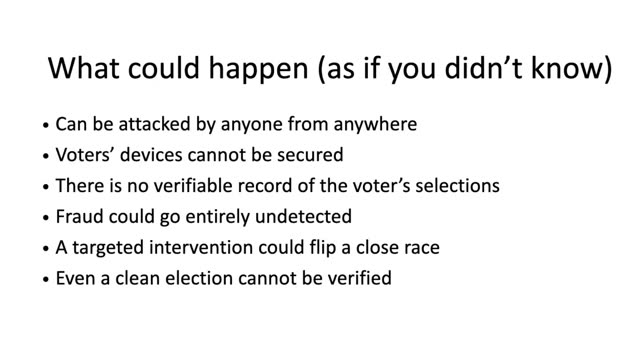
Voting Village·46 min
Barbara Simons
Makes the case that internet voting cannot be secured or verified, using past pilot breaches, failed trials and expert reviews as evidence.

Voting Village·31 min
Matt Blaze
Frames the core problem of US election integrity, separating real technical risks from unfounded distrust and the pull toward internet voting.

Voting Village·29 min
Carsten Schürmann
Argues that differences between voting channels, such as internet and mail-in ballots, can be weaponized to erode public trust in election results.