RLA Workshop
This recording is not on YouTube. It plays from the DEF CON media server; the button opens the file there.
Where
Voting Village
DEF CON 34
Duration
16 min
Walks attendees through a hands-on risk-limiting audit of a mock mayoral election, showing how random ballot sampling can confirm a reported winner.
Summary
The workshop runs a live demonstration of a risk-limiting audit using a mock mayoral election at the Voting Village. The presenter sets up the premise: a reported result says one candidate beat the others, and an auditor must check, with stated confidence, that the reported winner really won. The paper ballots carry serial numbers, so a specific ballot can be pulled from its precinct and read.
To choose ballots at random, the audience rolls two ten-sided dice to produce a number from zero to 99, which maps to a ballot. Each ballot is compared against a running tally for each winner-loser pair. A ballot for the reported winner nudges the tally up by one, while a ballot for the loser pushes it down by a larger amount, so the tally only climbs toward the stopping point when the sample consistently supports the outcome. The group works through both pairs until each reaches its threshold, which took thirteen ballots in this run. A parallel column shows how the same draws would look if the reported winner were wrong, drifting away from the stop point.
The takeaway is that a small random sample can confirm a wide-margin outcome with high confidence, and the tally rule is simple enough to run by hand. The presenter notes that sampling with replacement keeps the arithmetic easy, while the without-replacement version requires values that change with each draw and is better left to software.
Materials
Related talks
Voting Village·46 min
Barbara Simons
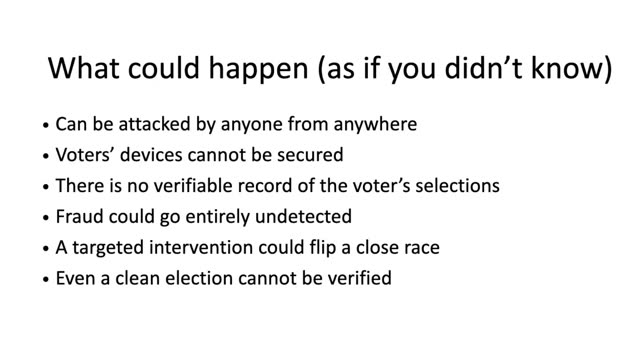
Makes the case that internet voting cannot be secured or verified, using past pilot breaches, failed trials and expert reviews as evidence.

Voting Village·29 min
Carsten Schürmann
Argues that differences between voting channels, such as internet and mail-in ballots, can be weaponized to erode public trust in election results.
Voting Village·28 min
John Odum
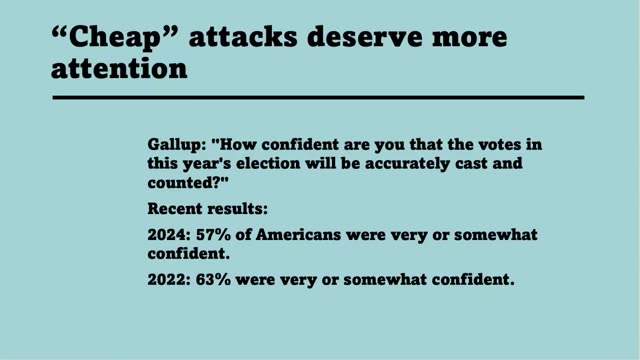
Shows how cheap, low-skill attacks such as website defacement, malicious voting apps, and phone-based misdirection could erode voter confidence in internet voting.