On the Weaponization of Voting Channels
This recording is not on YouTube. It plays from the DEF CON media server; the button opens the file there.
Where
Voting Village
DEF CON 34
Duration
29 min
Argues that differences between voting channels, such as internet and mail-in ballots, can be weaponized to erode public trust in election results.
Summary
The speaker, a computer scientist who has observed elections as an international delegate, starts from a worry: when a country offers several ways to vote, the results from each channel can differ, and those gaps can be exploited to undermine confidence in an outcome. He points to a 2020 Pennsylvania results screen whose lead appeared to shift as mail-in ballots were counted, and argues that public trust matters as much as accurate counting.
The main case study is Estonia, which lets voters cast ballots online or on paper. In the 2023 count, preliminary results appeared stable after the internet votes were checked against paper records, then changed sharply when internet ballots were uploaded. A party that had told supporters to avoid internet voting lost about half of its apparent support and challenged the result in the Supreme Court, which dismissed the case on procedural grounds. A survey with a political scientist colleague found a significant drop in trust in internet voting, with the political extremes losing confidence most.
He closes with untested ideas: withholding channel-level breakdowns, publishing no preliminary results, moving to a single uniform channel, and creating independent bodies that run channel-specific risk-limiting audits. He admits these are rough and may not be practical. The takeaway for practitioners is that trust in each voting channel needs protecting, and election officials should plan for it before it is exploited.
Materials
Related talks
Voting Village·46 min
Barbara Simons
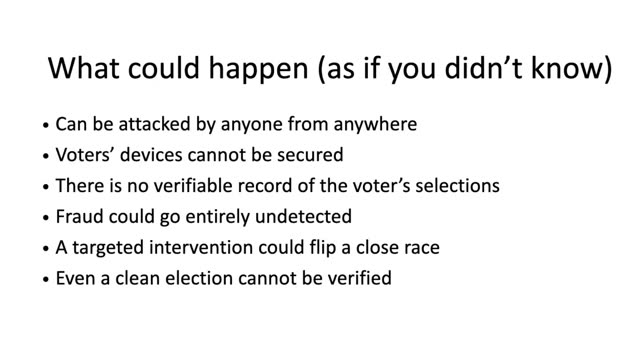
Makes the case that internet voting cannot be secured or verified, using past pilot breaches, failed trials and expert reviews as evidence.
Voting Village·28 min
John Odum
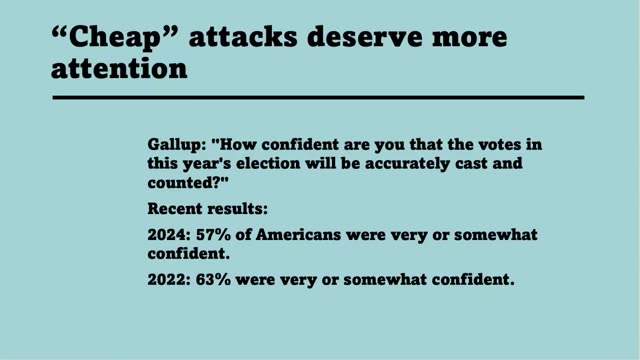
Shows how cheap, low-skill attacks such as website defacement, malicious voting apps, and phone-based misdirection could erode voter confidence in internet voting.

Voting Village·29 min
Hallvard Nygård
Shows how a lone citizen observer used public records requests and scraped election protocols to probe the paper-ballot process in Norway.