Low Skill, High Impact Attacks that Could Derail Internet Voting
This recording is not on YouTube. It plays from the DEF CON media server; the button opens the file there.
Where
Voting Village
DEF CON 34
Duration
28 min
Shows how cheap, low-skill attacks such as website defacement, malicious voting apps, and phone-based misdirection could erode voter confidence in internet voting.
Summary
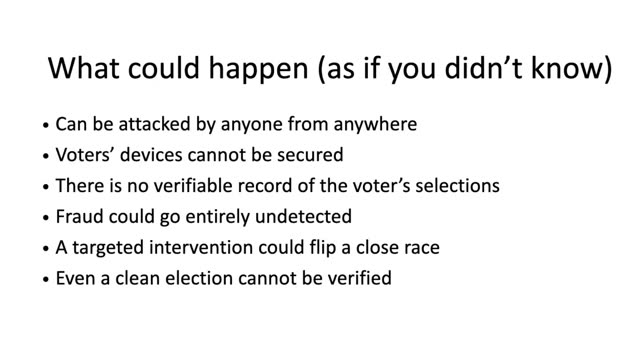
Local election administrator John Odum argues that large-scale internet voting will never earn the public trust needed for a credible election. He points to a 2024 survey in which only 36% of respondents had confidence in votes cast over the internet, and he contends that attacks aimed at confidence deserve as much attention as attacks that alter ballots.
He then walks through inexpensive options a moderately skilled adversary could use. These include defacing county election websites, publishing voter-history data to create false claims, phishing for content management system credentials, and distributing malicious voting apps or browser extensions. He also covers low-cost denial-of-service stressors that can take down a single county site and generate headlines. The most concerning case, in his view, is vote by phone. Using New Hampshire as an example, he estimates how many voters could be misdirected from purchased mobile contact lists, and he notes that a race decided by a tiny margin could be swung without changing any votes.
He closes by saying decentralization, usually seen as the strength of the American system, becomes an exposure when every jurisdiction runs its own online channel. The Q&A covered legislator education, the risk of a slippery slope toward wider online voting, and postage for absentee voters as an alternative. He presented the talk as a warning rather than a how-to, and offered no clear fix.
Materials
Related talks
Voting Village·46 min
Barbara Simons
Makes the case that internet voting cannot be secured or verified, using past pilot breaches, failed trials and expert reviews as evidence.

Voting Village·29 min
Carsten Schürmann
Argues that differences between voting channels, such as internet and mail-in ballots, can be weaponized to erode public trust in election results.

Voting Village·29 min
Hallvard Nygård
Shows how a lone citizen observer used public records requests and scraped election protocols to probe the paper-ballot process in Norway.