From Ballots to Code Independently Watching Norway's Election
This recording is not on YouTube. It plays from the DEF CON media server; the button opens the file there.
Where
Voting Village
DEF CON 34
Duration
29 min
Shows how a lone citizen observer used public records requests and scraped election protocols to probe the paper-ballot process in Norway.
Summary
The talk opens with a Norwegian observer who was escorted out of a public hand count by police after photographing it. That episode frames the rest of the talk, which asks how paper-ballot elections can still be watched, questioned and checked. The speaker gives a short primer: votes are counted by hand at each polling station, then transported and scanned for a second count that feeds a closed-source national system.
The middle section covers four findings. Ballot stamps bought abroad looked nearly identical to genuine ones, and records requests showed many municipalities using stamps that are easy to copy. A transport box was shown being stuffed in seconds, and an unsealed ballot box was reported on election night. The central system's source code was requested under open records law, but only partial files came back, with later versions withheld on national security grounds. Roughly 739 information requests produced more than a thousand protocol PDFs, which were converted to structured data. The analysis flagged seat changes between counts, large gaps between first and second counts, and ballot-stuffing indicators, many of which traced back to a display bug in an emergency release.
The closing advice is practical. Request in writing that count notes be preserved before election day, since many were discarded. Record who said and ordered what, file complaints quickly because the window is only four days, and observe openly while staying calm. The speaker argues that public scrutiny of election procedures and the software behind them remains rare and is still needed.
Materials
Related talks
Voting Village·31 min
Matt Blaze
Frames the core problem of US election integrity, separating real technical risks from unfounded distrust and the pull toward internet voting.
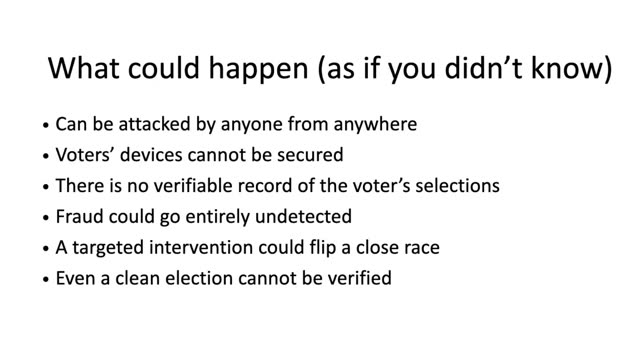
Voting Village·46 min
Barbara Simons
Makes the case that internet voting cannot be secured or verified, using past pilot breaches, failed trials and expert reviews as evidence.
Voting Village·29 min
Carsten Schürmann
Argues that differences between voting channels, such as internet and mail-in ballots, can be weaponized to erode public trust in election results.