Election Security and Technology
This recording is not on YouTube. It plays from the DEF CON media server; the button opens the file there.
Where
Voting Village
DEF CON 34
Duration
31 min
Frames the core problem of US election integrity, separating real technical risks from unfounded distrust and the pull toward internet voting.
Summary
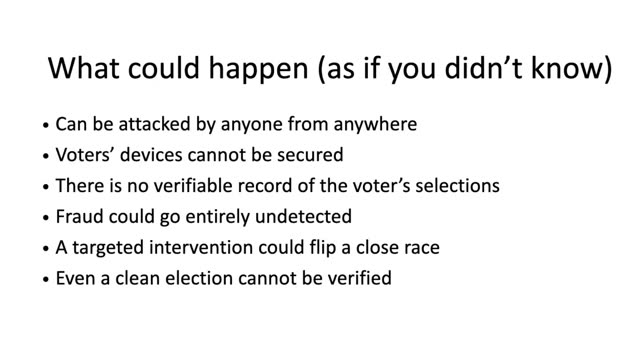
Matt Blaze, president of the Election Integrity Foundation, opens the Voting Village's morning session with a broad introduction to election security. He describes a tension that is hard to resolve: serious technical weaknesses exist in many parts of US election equipment, yet no credible evidence has shown that any of them has changed a US election outcome. He splits the discussion into three problems, the technical one, cynical distrust fed by unfounded claims, and unwarranted optimism about internet voting, and says he is most hopeful about the first.
He reduces the technical problem to a simple question: does the certified result match the votes cast? That is hard in practice because US ballots are complex, errors cannot easily be redone, no neutral third party can be trusted, and the secret ballot must be preserved. Blaze separates visible failures, such as registration chaos on election day, from silent tally errors. He credits two ideas with making flawed software tolerable: Ron Rivest's software independence and Philip Stark's risk-limiting audits. Paper optical-scan ballots make these audits possible, while touchscreen machines do not.
He then turns to denialism that rarely specifies how an alteration would work, and to the appeal of voting from a smartphone. Voting is irreversible in a way banking is not, and remote voting breaks software independence. His takeaways for technologists are to explain clearly what elections can and cannot guarantee, and to work as poll workers.
Materials
Related talks
Voting Village·46 min
Barbara Simons
Makes the case that internet voting cannot be secured or verified, using past pilot breaches, failed trials and expert reviews as evidence.
Voting Village·29 min
Hallvard Nygård
Shows how a lone citizen observer used public records requests and scraped election protocols to probe the paper-ballot process in Norway.
Voting Village·26 min
Richard DeMillo
Argues that election security failures persist when known vulnerabilities become normalized, drawing on the Challenger and Columbia investigations and a Georgia voting lawsuit.