When AI Goes Offensive, Exploiting the Unexploitable
Where
Talks
LASCON 2025
Duration
54 min
Demonstrates an AI agent that chains recon and misconfigurations into access-control exploits against web and cloud targets.
Summary
The talk argues that manual reconnaissance and scanner-driven testing struggle with scale and depth, so the speaker's team has been building offensive AI agents that reason about a target the way a red teamer would. The agent design adds observe and judge steps to the usual reason-act-learn loop, so false positives get filtered before anyone spends hours chasing them. The stack described includes a model, a vector store that remembers past attempts, an agent framework and a crawler.
Two demonstrations follow. In the first, an agent starts from a token obtained with limited access in an assumed-breach scenario, reads its permissions, enumerates directory and application resources, and plans a multi-stage chain that ends with persistent backdoor accounts in a Microsoft Graph environment. When a step fails, the error is passed to another agent that revises the approach. In the second, a single agent works through an unauthenticated file-read flaw in a Kafka Connect deployment, creating a malicious connector and confirming access to sensitive system files.
The takeaways are practical. Agents need a defined role, a narrow scope and explicit safety constraints in their prompts, and a human should steer them early. Model choice and token cost shape results, and the speaker sees the most value in recon and in carrying context forward between steps.
Related talks

Talks·44 min
Paul Brownridge
Shows how chatbot agents on public websites can be coaxed into leaking client data through prompt manipulation and encoding tricks.

Adversary Village·26 min
Dominika Pietrzak · Ibai Castells
Shares lessons from building reusable, reliable offensive AI agents for client web application tests, covering evaluation and safety controls.
AI Village·30 min
Stav Cohen
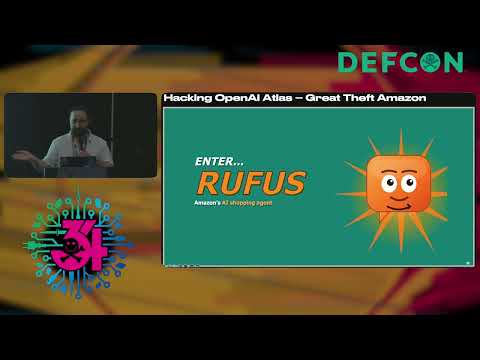
Shows how agentic browsers such as Atlas, Comet, Claude in Chrome and Gemini can be hijacked through poisoned pages, calendar invites and browser history.