Field Notes on Offensive Agents - Reusability, Reliability
Where
Adversary Village
DEF CON 34
Duration
26 min
Shares lessons from building reusable, reliable offensive AI agents for client web application tests, covering evaluation and safety controls.
Summary
The speakers, from a security consultancy, start with the gap between flashy offensive agent demos and systems that can be trusted on client engagements. Their framework runs in four stages: discovery and reconnaissance, planning of vulnerability hypotheses, attack by specialised agents, and validation. Models are pluggable so different agents can use different models, and shared tools such as a browser can be reused across agents. A human still reviews findings before anything reaches a client report.
For reusability, they recommend turning a prompt that works for one vulnerability class into a template, sharing tooling instead of duplicating it, and packaging single agents so consultants can use them in their own harnesses. For reliability, structured output makes final reports easy to parse, validators cut false positives, and retries with backoff stop long runs from crashing when an API or tool fails. Authentication was the hardest problem, so they moved login flows into a dedicated subsystem that tracks sessions, cookies and keys.
On evaluation, they argue teams must define what success means, choose deterministic measures where possible, and decide what pass rate justifies release. They tested against internal labs, then bug bounty targets, to judge new models and prompt changes. Safety measures include an ask-human tool, a proxy that blocks out-of-scope hosts, careful wording in agent setup, and a kill switch. Their takeaway is that agents work best as a force multiplier running alongside human testers.
Materials
Related talks
AI Village·30 min
Stav Cohen
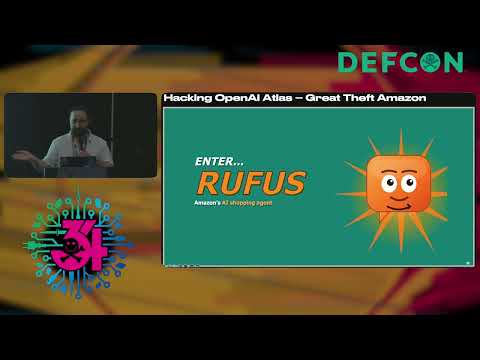
Shows how agentic browsers such as Atlas, Comet, Claude in Chrome and Gemini can be hijacked through poisoned pages, calendar invites and browser history.

AI Village·49 min
Thomas Mason · Tahseen Rabbani
Shows how Google's SynthID image watermark can be stripped with light diffusion regeneration and a fast offline surrogate detector trained on paired images.
Bug Bounty Village·23 min
Amaan Pathan
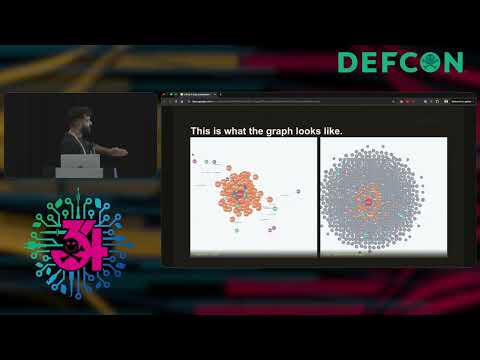
Shows a multi-agent bug hunting workflow that maps an application, routes candidate findings to specialized agents, and reports only issues it can reproduce.