Voice Cloning Air Traffic Control: Vulnerabilities at Runway Crossings
Demonstrates how real-time AI voice cloning and software-defined radios can inject fraudulent air traffic control clearances on unencrypted VHF frequencies.
Summary
Unencrypted VHF Aviation Communications
Civil aviation relies almost entirely on analog, unencrypted Very High Frequency (VHF) amplitude modulation (AM) radio channels for air traffic control (ATC) voice clearances between towers and pilots.
AI Voice Cloning and Real-Time Synthesis
Andrew Logan demonstrates how neural voice cloning models trained on publicly available LiveATC feeds can replicate specific air traffic controller voices in near-real time.
Over-the-Air Transmission and Runway Hazard Scenarios
Transmitting cloned voice commands using software-defined radios (SDRs) creates severe safety hazards, including spoofing takeoff clearances or runway crossing authorizations in low-visibility conditions.
Mitigations and Future Aviation Protocols
Protecting air traffic communications requires transitioning to authenticated digital datalinks (such as CPDLC) and implementing voice watermarking and spatial RF transmitter verification.
Related talks
Main Stage·21 min
Gal Zror
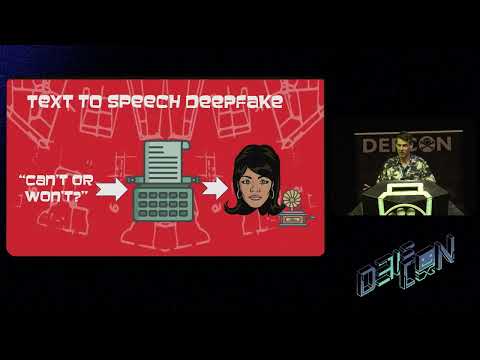
Demonstrates real-time executive impersonation using open-source deepfake video and audio models running on commodity GPU hardware.
Creator Stage·19 min
Katherine Rackliffe
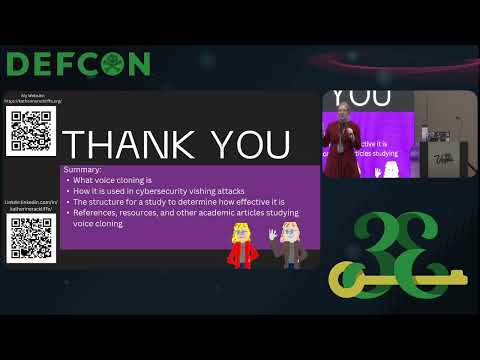
Presents empirical results from a university research study evaluating user vulnerability and defensive safeguards against AI voice-cloned vishing attacks.

Creator Stage·26 min
Mark Foudy
Demonstrates how deep learning voice cloning bypasses enterprise voice verification systems in realistic adversarial simulations.