There and Back Again
This recording is not on YouTube. It plays from the DEF CON media server; the button opens the file there.
Where
Voting Village
DEF CON 34
Duration
28 min
Presents a forensic examination of a Dominion voting system used in a live Puerto Rico election, covering its control, cryptography and software failures.
Summary
The talk recounts how a small forensics team came to examine a Dominion voting system from Puerto Rico after a federal request. They imaged the election management system and several machines, then worked in a conservative threat model: a skilled attacker with access to the local network, not an insider or stolen keys. Much of the effort went into decrypting and deobfuscating self-modifying binaries, and the team had to set aside earlier material with broken chain of custody.
The findings cover four areas. LTE modems were active during operation, so the system was not air-gapped. Passwords were reused, weak or hard-coded, and audit databases shared the attack surface of the main system. Cryptography showed weak entropy, IV reuse, hard-coded material and cleartext key handling. At least twelve high or critical CVEs affected commercial components, with patches available before certification, and the code relied on obfuscation and stored credentials in plain text. The speakers say they found no evidence that votes were altered, but they also could not rule out exploitation with the data they had.
The recommendations push for a constrained, immutable and air-gapped appliance, open source code with reproducible builds and published hashes, and append-only audit logs. They argue that certification should test deployed configurations and real cryptographic use, not only FIPS-validated modules, and that independent risk-limiting audits against paper records are needed. The talk closes by announcing a nonprofit effort to fund open review of voting software.
Materials
Related talks

Aerospace Village·28 min
Rose Idan
Presents an empirical study of 126 open-source satellite flight software repositories, covering maintenance state, severity, weakness types and affected subsystems.
Voting Village·46 min
Barbara Simons
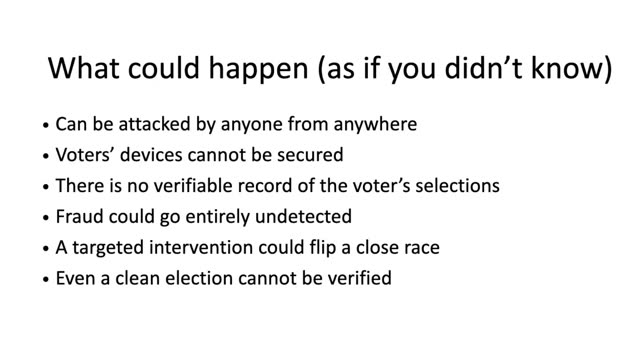
Makes the case that internet voting cannot be secured or verified, using past pilot breaches, failed trials and expert reviews as evidence.
Voting Village·29 min
Carsten Schürmann
Argues that differences between voting channels, such as internet and mail-in ballots, can be weaponized to erode public trust in election results.