Election Observation - Merely Allowing People to Watch is Not Enough
This recording is not on YouTube. It plays from the DEF CON media server; the button opens the file there.
Where
Voting Village
DEF CON 34
Duration
40 min
Argues that election observation needs designed programs, legal access, shared documentation and technical expertise, not just admitting people to watch.
Summary
The talk opens by asking why election observation is needed at all. The speaker argues that voters cannot simply trust election administrators, since history shows that most election misconduct comes from officials and that ordinary carelessness is common, especially across the roughly two million people who run a US election. He calls for a modest, institutionalized distrust that keeps people paying attention.
The middle of the talk catalogs barriers. Some states limit each party to one observer per polling place, which shuts out insurgent candidates. Photographing voted ballots is banned in ways that also block useful documentation. Vendors often bind counties with NDAs over procedure manuals, and a Dutch internet voting case showed key generation happening behind closed doors. Observers also face hard problems: a helpline that could issue replacement credentials, a control that is impossible to prove absent, a test that failed a sanity check, and seal logs and zero tapes that were ritualized rather than checked. Long shifts and frayed staff make access harder still.
The speaker concludes that effective observation requires organization. Partisan, nonpartisan and international missions each have roles, with passive observers producing reports and active observers intervening quickly. Teams need legal and technical members, and they need to share data. He argues for open training materials, a public record of observations and observer access to the same documentation election staff use. The takeaway for practitioners is that admitting people to the room is not enough without a design that makes the process verifiable.
Materials
Related talks

BioHacking Village·22 min
James Utley
Explains how AI-generated papers, scam journals and gatekeeping networks push fabricated science into the public record, and offers red flags for spotting it.
Voting Village·46 min
Barbara Simons
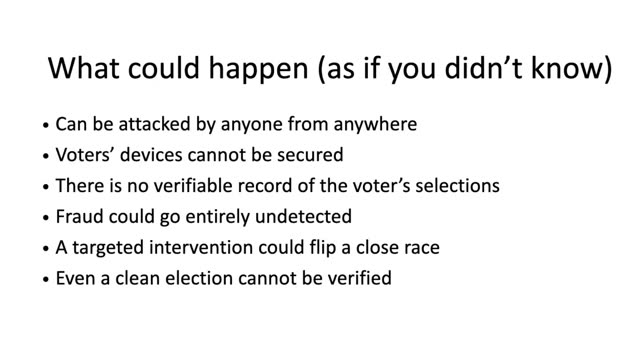
Makes the case that internet voting cannot be secured or verified, using past pilot breaches, failed trials and expert reviews as evidence.
Voting Village·29 min
Carsten Schürmann
Argues that differences between voting channels, such as internet and mail-in ballots, can be weaponized to erode public trust in election results.