Securing Generative AI
Where
Talks
LASCON 2023
Duration
34 min
Shows how familiar security APIs like redaction, threat intel and access control can be inserted into generative AI chat flows.
Summary
Rob Truesdell frames generative AI security through the "alternate 1985" from Back to the Future Part II: a warped present full of new problems, including data leakage, manipulated models, legal questions and attacks on prompts. His point is that most of these have familiar answers from enterprise and network security. The place to apply them is the API layer between users, the chat interface, the model and surrounding components. He lists data classification and filtering, threat intelligence lookups, strong authentication, fine-grained access control, tamper-resistant audit logging and digital signing of content.
The middle of the talk shows a simple chat app built on the OpenAI API. Prompts pass through a redaction service that removes items such as Social Security numbers before reaching the model, and responses are checked for malicious domains and URLs before they go back to the user, with suspicious links defanged or removed. Every exchange is logged. He concedes that pattern matching only catches known formats and cannot adapt to new inputs on its own. For authorization, he recommends checks in the orchestration layer before a vector database is queried, and suggests attribute-based policies that consider factors such as time of day or employee tenure. Audience questions touched on explainability and detecting prompt injection, where extracting indicators for threat intelligence lookups was the current best option.
He closes by calling this no silver bullet. Audit logging and data protection can be deployed today, while access control and content authenticity are achievable with more custom work. A shared trust framework for generative AI is still in progress and needs community samples. The takeaway for practitioners is that the controls already exist and the API layer is a logical place to add them.
Related talks

Talks·22 min
Christian Paquin
Explains how cryptographically signed content credentials like C2PA can help verify whether online images and videos are authentic.
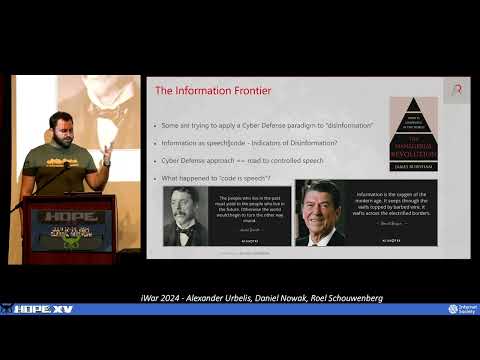
Talks·53 min
Alexander Urbelis · Daniel Nowak · Roel Schouwenberg
Surveys information warfare, from ransomware and disinformation to decentralized networks and crypto regulation.

Talks·43 min
Aviral Srivastava
Demonstrates three attacks on the tool-call layer of AI agents and the controls that validate model-generated actions.