SE Village - Chris Hadnagy - 7 Jedi Mind Tricks: Influence Your Target without a Word
Chris Hadnagy reveals nonverbal influence, body language cues, and psychological rapport-building tactics for social engineering.
Summary
### The Power of Nonverbal Influence At 01:30, Chris Hadnagy introduces the foundational premise of nonverbal communication in social engineering: human targets assess credibility, friendliness, and threat potential in a fraction of a second before verbal interaction even begins. When social engineers rely solely on scripted pretexts without aligning their physiological signals, unconscious microexpressions and incongruent body language trigger instinctual suspicion. Mastering nonverbal cues allows an operator to establish psychological comfort, lower interpersonal resistance, and project natural authority or harmlessness effortlessly.
### The Duchenne Smile and Genuine Expression At 04:31, Hadnagy delves into facial muscle dynamics, focusing on the distinction between voluntary social smiles and the genuine "Duchenne smile." He explains that while anyone can consciously contract the zygomatic major muscles to pull back the corners of the mouth, an authentic smile involuntary recruits the orbicularis oculi muscles, crinkling the skin around the eyes. Practicing expressions before a mirror or around trusted peers (discussed around 07:33) helps practitioners eliminate forced, predatory grins that set off subconscious red flags during close encounters.
### Ventral Displays and Head Tilts Starting at 10:33, the lecture examines ventral fronting and neck orientation as universal signals of open communication. Keeping the chest, torso, and vital organs unobstructed communicates vulnerability and non-threatening intent. At 28:46, Hadnagy details the psychological impact of the subtle head tilt, which exposes the carotid artery. This instinctive posture conveys curiosity, empathy, and active listening, making a target feel heard and significantly increasing their willingness to assist or divulge sensitive information.
### Paralanguage and Vocal Control At 18:04, Hadnagy transitions from visual signals to paralanguage—the pitch, tone, pacing, cadence, and inflection of the human voice. How words are spoken frequently overrides what words are used. Altering vocal inflection to conclude statements with a calm downward cadence exudes authority, whereas speaking with warm upward inflections can disarm guarded staff members during both phone pretexts and on-site physical security assessments.
### Contextual Nonsexual Touch and Proxemics At 21:07, Hadnagy explores proxemics and the strategic application of brief, nonsexual touch. A gentle, culturally appropriate tap on the shoulder or elbow can instantly build rapport and foster an unconscious bond of compliance. However, through an interactive demonstration at 25:40, he demonstrates the dangers of miscalibrating personal space: invading physical boundaries too rapidly triggers immediate fight-or-flight defensiveness, compromising the pretext.
### Elicitation, Power Posing, and Pretext Integrity At 33:17, Hadnagy demonstrates practical conversational elicitation scenarios, such as adopting the role of a lost visitor holding a building map to manipulate security personnel into volunteering directions into restricted zones. At 45:31, he touches upon Amy Cuddy's power posing research to manage adrenaline spikes and project confidence before walking into target facilities. Finally, at 50:02, he delivers a core rule of physical penetration testing: never break pretext, regardless of friction or confrontation, maintaining emotional composure and staying completely in character.
(AI summary — Gemini 3.8 Flash)
Related talks
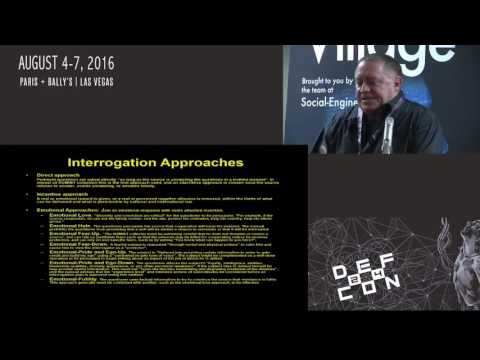
Social Engineering Village·52 min
Comparing formal government interrogation methodologies with offensive social engineering and human intelligence elicitation tactics.

Rogues Village·34 min
James Harrison
Explores the psychological mechanics of theatrical pickpocketing, misdirection cues, and physical spatial awareness.

Rogues Village·58 min
0x90
Deconstructs linguistic deception, magician outs, psychological forces, and equivoque techniques used to steer human choice.