Quiet! How Local-First Software Can Keep Remote Teams Safe and More
Where
Talks
A New HOPE
Duration
52 min
Shows how a Tor-based, peer-to-peer team chat app syncs data without a cloud server, and how that approach could extend to other tools.
Summary
The talk starts from the argument that cloud dependence has weakened free software's ability to hold large tech companies accountable. When data and relationships live on company servers, the freedoms to run, study, change and redistribute code offer little practical leverage. The speaker points to Reddit's move away from releasing its code as an example, and describes servers as creating censorship, lock-in, volunteer burden and competitive problems.
The middle of the talk is a live demo of Quiet, a team chat app in which members' devices connect directly to each other over Tor onion services. Invitations work through an onboarding service on the owner's device, and state is synced with a conflict-free replicated data type over an IPFS-based gossip layer. The demo covered message sync, sharing a large file and inviting a new user. Performance tests showed average delivery under two seconds at modest message rates, with a delivery spike in a 100-user test. Known gaps include no mobile push notifications without a server, timed deletion not yet implemented, a single owner who must be online to issue invites, and no security audit yet.
The closing section compares Quiet with related projects such as Briar, Cabal, Pinecone and Secure Scuttlebutt, and surveys the local-first software movement. The speaker's main request is for small groups with real privacy needs to trial the tool and report back, and for developers to contribute to the effort.
Related talks

Talks·38 min
Lambda Calculus
Explains how offline Pirate Box networks and sneakernet file sharing can move information past censorship and internet gatekeepers.
Talks·44 min
Josh King
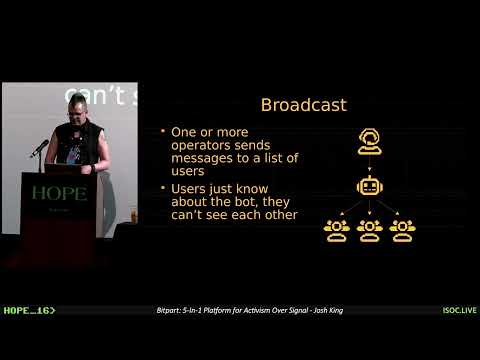
Shows how Bitpart runs one-to-many Signal bots for tiplines, help desks, broadcasts, and eSIM and VPN code distribution.

Talks·18 min
Harry Halpin
Explains how the NymVPN mixnet hides traffic metadata from global observers and how its two modes compare.