Remote ID, ESP32s, and the Packet Trail to Friend or Foe
Where
Packet Hacking Village
DEF CON 34
Duration
46 min
Shows how a Remote ID drone detector built from ESP32 sensors handles weak Wi-Fi and Bluetooth signals without turning them into overconfident alerts.
Summary
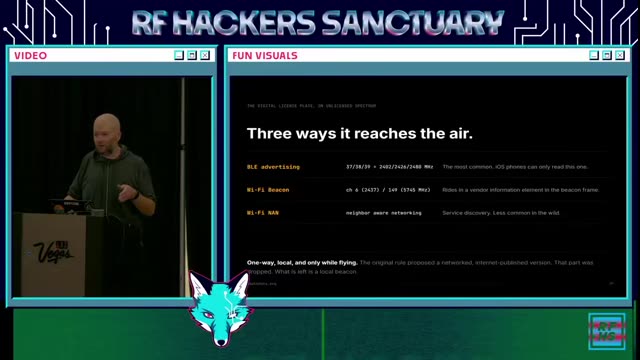
The talk opens with an Android airspace app that failed to pick up the presenters' own DJI drone. Investigating Remote ID showed that this drone did not broadcast it, so the team fell back on Wi-Fi SSIDs and manufacturer OUIs as weaker clues. They built a simulator to test detection against known traffic and found that Remote ID arrives as several separate packets, so partial captures are common.
The sensor work moved to ESP32 boards. A C5 was dropped because switching to 5 GHz added delays too long for continuous scanning, so the team standardized on ESP32-S3 nodes. Firmware updates over a single USB link failed on one board, which turned out to be a loose pin, and the hardware later moved to a locally fabricated PCB. A nightly AI-assisted search grew the signature list to hundreds of manufacturers. Bluetooth signal strength proved unreliable for triangulation, so the scoring favored agreement across several packets and sensors, with confidence that expires over time.
The main takeaway is that one packet, one SSID or one OUI should not drive an alert, since those fields can be spoofed and captures are often incomplete. A live demo showed the badges and the Android app detecting a real drone. The presenters also noted that some commercial tools missed certain drone types, and said the hardware and code are planned for public release after the conference.
Materials
Related talks

Radio Frequency Village·55 min
Lozaning
Walks through building a private LTE network from base station and SIM provisioning through to telephony and a PSTN bridge, while staying within licensing rules.
Radio Frequency Village·29 min
Greg
Explains how drones appear on the RF spectrum, how Remote ID and DJI control links can be detected and decoded, how they can be spoofed or replayed, and where RF sensing falls short.
Radio Frequency Village·37 min
hamspiced
Walks a self-described non-expert through building resonant NFC repeater antennas, from LC tank circuits and VNA tuning to parasitic-capacitance PCB designs.