Panel - Lets Encrypt Minting Free Certs to Encrypt the Entire Web
The team behind Let's Encrypt discusses automated certificate authority architecture, ACME protocols, and free HTTPS for the web.
Summary
### The Crisis of Web Encryption and CA Economics Historically, deploying HTTPS across the World Wide Web was constrained by financial cost, operational complexity, and bureaucratic friction. Traditional Certificate Authorities (CAs) charged substantial annual fees per domain, required manual verification procedures, and forced administrators through convoluted cryptographic CSR generation and installation steps. Consequently, smaller websites, personal blogs, and non-profit services remained unencrypted, leaving users vulnerable to surveillance, ISP traffic injection, and man-in-the-middle (MitM) attacks. This panel brings together engineers from the Electronic Frontier Foundation (EFF), the Internet Security Research Group (ISRG), Yahoo, and academic partners to introduce Let's Encrypt, an initiative designed to provide free, automated, and open digital certificates for every domain on the internet.
### Architecture of the Let's Encrypt Certificate Authority Let's Encrypt was engineered from the ground up to eliminate human overhead through complete automation. Operating as a public-benefit certificate authority managed by ISRG, the system relies on open-source infrastructure capable of minting millions of X.509 certificates at zero marginal cost. To ensure security without manual verification, Let's Encrypt focuses strictly on Domain Validation (DV), proving that an applicant exercises control over the domain name in question. By making certificates completely free and lowering the validity period to 90 days, Let's Encrypt encourages automated renewal, limits the operational window of compromised private keys, and accelerates cryptographic agility across the global ecosystem.
### The ACME Protocol and Automated Domain Validation Central to Let's Encrypt is the Automated Certificate Management Environment (ACME) protocol, an open standard designed to orchestrate the entire certificate lifecycle via JSON-over-HTTPS. When a web administrator requests a certificate, the ACME client negotiates validation challenges with the CA: - **HTTP-01 Challenge:** The CA instructs the client to place a cryptographically signed token at a designated URI path (`/.well-known/acme-challenge/`). The CA verifies possession by fetching the resource via standard HTTP over the public internet. - **DNS-01 Challenge:** For systems behind firewalls or multi-server clusters, the client writes a specific TXT record to the domain's authoritative DNS zone, verifying control over DNS records. - **TLS-SNI-01 Challenge:** Proof of control via TLS handshakes presenting dynamically generated self-signed certificates containing challenge tokens.
### Boulder CA Implementation and Certificate Issuance The backend CA engine, named Boulder, is built in Go and architected around decoupled microservices communicating over AMQP messaging queues. Boulder handles validation, authorization, rate limiting, and interaction with Hardware Security Modules (HSMs) containing root and intermediate private keys. By separating validation logic from key-signing operations, Boulder minimizes attack surfaces and ensures high availability. Let's Encrypt launched by cross-signing its intermediate certificates with established commercial CAs (IdenTrust) to achieve immediate trust in major desktop and mobile web browsers while its own ISRG Root X1 propagates into root stores.
### Challenges in Revocation, Root Trust, and Web Security The panel addresses critical security considerations inherent in issuing certificates at massive scale: - **Revocation Scalability:** Traditional CRLs (Certificate Revocation Lists) and OCSP (Online Certificate Status Protocol) struggle under hundreds of millions of certificates. Short certificate lifetimes (90 days) significantly reduce dependency on revocation infrastructure while OCSP stapling is actively promoted. - **Domain Squatting and Phishing:** Let's Encrypt validates domain control, not legal identity or content legitimacy. The panel emphasizes that HTTPS secures transmission against tampering and eavesdropping, while content authenticity and anti-phishing protection belong in browser reputation layers. - **Ecosystem Impact:** Automated certificate provisioning changes web security norms, moving the internet toward universal TLS adoption, HTTP/2 compliance, and eliminating unencrypted HTTP as an acceptable standard.
(AI summary — Gemini 3.8 Flash)
Related talks

Cloud Village·12 min
Kevin Chen
Kevin Chen breaks down Public Key Infrastructure (PKI) concepts, removing the intimidation around TLS certificates, trust chains, and cloud CAs.
Village Presentations·22 min
Nick Sullivan
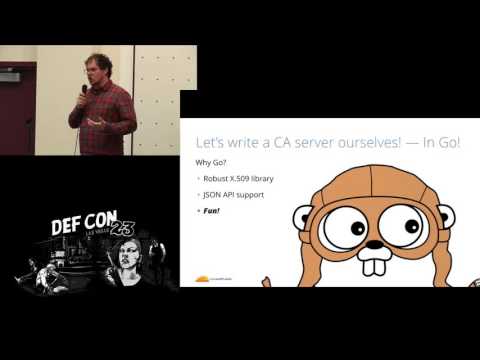
Cloudflare head of cryptography Nick Sullivan introduces CFSSL, an open-source Go toolkit for automated TLS certificate authority operations and PKI bundling.

Crypto and Privacy Village·44 min
Analyzing certificate revocation protocols including CRL and OCSP, exploring the systemic vulnerabilities and privacy leaks undermining public PKI.