OpSec for Grandma
Where
Talks
ShmooCon 2025
Duration
13 min
Shows how to protect older relatives from scams using Macs, DNS filtering, paper password books, and simple family rules.
Summary
Rich Mogull starts from the point that security professionals often become unpaid IT support for their parents, relatives and friends. He says older family members are frequent targets, with scams arriving through email phishing, pop-ups served by ad networks, and cold calls or texts posing as tech support.
The middle of the talk lays out a five-part routine he says has nearly eliminated incidents in his own family over the past year. It begins with favouring Macs for their stronger default protections, and with locking Windows machines to the app store. Passwords go into a paper notebook, one account per page, written in simple characters that are easy to read. The most important control is a paid DNS filtering service run as a device agent, so protection follows the device off the home network and blocks malicious domains even when a link arrives by email. He also recommends a paid search engine rather than ad-funded search, and a few household rules: legitimate companies won't ask for passwords or bank details by phone or email, nothing gets installed on request, and relatives should call him rather than attempt fixes themselves.
In the Q&A he compares DNS options, saying a self-hosted Pi-hole needs too much upkeep, and recommends iOS for phones while warning against installing configuration profiles. The takeaway is that one trusted person maintaining low-friction defaults protects relatives better than expecting them to spot scams on their own.
Related talks

Talks·46 min
Firat Acar · Moritz Thomas
Walks through real physical intrusions where red teamers used pretexts, cloning and a rogue Raspberry Pi to breach client sites.
Talks·44 min
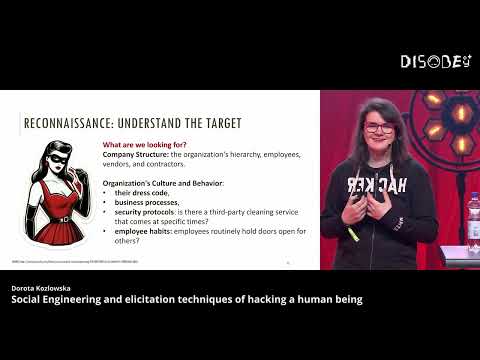
Dorota Kozlowska
Walks through social engineering phases, influence tactics, elicitation and physical intrusion examples drawn from red team engagements.

Ground Floor·20 min
You Nakatsuru · Fumiya Imai · Viet Luu
Compares physical intrusion defenses in Japan and the U.S., showing how social engineering exploits culture and staff habits.