Marte Loge - Tell me who you are and I will tell you your lock pattern
Marte Løge analyzes Android lock patterns, demonstrating how demographic and psychological traits make user unlock gestures predictable.
Summary
### Behavioral Biometrics in Mobile Authentication Android lock patterns were introduced as an intuitive, visual alternative to numeric PIN codes and alphanumeric passwords, allowing users to authenticate by connecting a 3x3 grid of nine dots in a single continuous stroke. While patterns lack semantic linguistic meaning (such as names or dictionary words), human cognitive habits introduce significant predictability into how patterns are generated. In this presentation, Marte Løge details findings from her master's research at the Norwegian University of Science and Technology (NTNU), evaluating the complexity, predictability, and structural vulnerabilities of thousands of real-world user-generated Android lock patterns.
### Research Methodology and Pattern Scoring Framework To analyze pattern security, Løge conducted an empirical study involving over 850 participants who generated ~4,000 distinct lock patterns across three specific operational contexts: unlocking a smartphone, authenticating into a shopping application, and securing a mobile banking account. The research evaluated patterns using an objective complexity scoring model that quantified: - **Length (Node Count):** The total number of contact points utilized (minimum 4, maximum 9). - **Physical Layout and Vector Direction:** Sequence direction, turns, acute angles, and transitions between adjacent and non-adjacent nodes. - **Crossover Intersections:** Number of line crossings where strokes intersect previously traversed paths without contacting intermediate unselected nodes. - **Visual Complexity:** The cognitive difficulty of observing and reproducing the pattern during "shoulder surfing" attacks.
### Structural Weaknesses and Starting-Point Predictability Despite a theoretical keyspace of 389,112 possible Android lock patterns, user choices cluster heavily within a tiny, predictable subset: - **Dominance of Starting Points:** An overwhelming 77% of all participants began their lock pattern in one of the four outer corners of the 3x3 matrix. - **Upper-Left Corner Bias:** A staggering 44% of participants initiated their pattern specifically from the top-left dot (node 1), directly mirroring western reading and writing habits. - **Node Length Clustering:** The average pattern length was only five nodes, providing merely 7,152 possible combinations. Very few participants selected eight or nine nodes (less than 4% on average), despite 8- and 9-node patterns offering the largest theoretical combinations (over 140,000 possibilities each). - **Letter and Shape Mimicry:** Many users drew recognizable Latin alphabet letters (such as 'C\, 'L\, 'N\, 'S\, or 'M\), frequently corresponding to their own initials or those of significant others.
### Demographic Factors: Handedness, Age, and Context The study examined correlations between user demographics, operational sensitivity, and pattern strength: - **Handedness and Ergonomics:** Surprisingly, left-handed participants exhibited nearly the same top-left starting bias as right-handed users, indicating that cultural reading direction exerts a stronger cognitive influence than physical thumb reach. - **Age Differences:** Younger participants consistently created longer, more complex patterns across all scenarios compared to older demographics. - **Application Context Sensitivity:** Participants created slightly longer patterns for mobile banking applications than for daily smartphone unlocking. However, shopping applications exhibited remarkably low complexity scores, reflecting user unwillingness to endure friction for non-financial apps.
### Implications for Android Security and Defensive Recommendations The findings prove that default Android pattern implementations suffer from severe entropy deficits comparable to four-digit PINs: - **Shoulder Surfing and Smudge Attacks:** Because patterns are short, corner-centric, and drawn in continuous strokes, they are exceptionally vulnerable to visual observation and oily touchscreen smudge analysis. - **Brute-Force Attack Optimization:** Attackers can drastically optimize dictionary and Markov-chain guessing algorithms by prioritizing top-left corner sequences, 4- to 5-node lengths, and common letter shapes. - **Hardening Strategies:** To achieve acceptable security, users should avoid starting from the four corners, introduce line crossovers, select at least eight or nine nodes, and disable visual trace feedback in Android settings to prevent casual visual eavesdropping.
(AI summary — Gemini 3.8 Flash)
Related talks

War Stories·49 min
Jeffrey Knockel · Mona Wang
Exposes flawed custom network encryption in popular Chinese IME keyboard apps that allow network eavesdroppers to intercept keystrokes from 800 million users.
Briefings·41 min
Alex Gonzalez
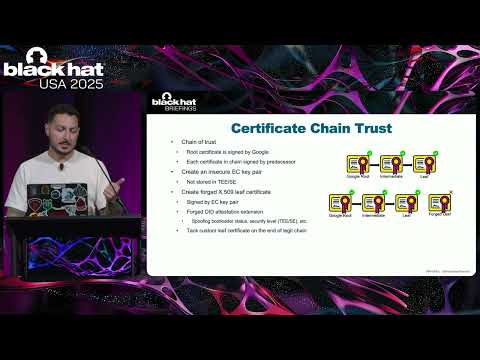
Android key attestation provides a way for a device's secure hardware to verify that cryptographic material is in secure hardware, protected against compromise of the Android OS.

Black Hat·34 min
Bin Ma · Xiangxing Qian · Wei Wen · Zhenyu Zhu
Presenters detail vulnerability discovery and exploitation in A Deep Dive into Privacy Dashboard of Top Android Vendors.