Making oRAT, Go
Where
Talks
Objective by the Sea v5.0
Duration
36 min
Shows how a custom command-and-control server can coax a Go-based macOS RAT into revealing its capabilities.
Summary
The talk examines oRAT, a macOS malware sample written in Go and tied to the Earth Berberoka group. It starts with triage: the binary is a UPX-packed 64-bit Mach-O that expands to a much larger executable because Go statically bundles its libraries. The speaker walks through the difficulties of reversing Go binaries, including strings that are not null-terminated and confuse disassemblers, and shows how to separate third-party code from the malicious logic.
Rather than reverse engineering every feature by hand, the analysis recovers the encrypted configuration appended to the file, decrypts it with AES-GCM, and re-encrypts a copy pointing at a custom server. Because the implant multiplexes all its traffic over one connection using the smux library, the speaker built a matching Go server that opens streams and sends routed tasking requests. Process, file and network monitors then recorded the implant carrying out commands such as info collection, file download, a tunnel, a port scan and self-deletion. A separate section covers a local privilege escalation zero-day in Parallels' installer, presented as an aside.
The main takeaways are that studying APT malware reveals its capabilities and sophistication, and that dynamic analysis through a purpose-built server can be more efficient than heavy static reversing. The speaker also notes that a reconfigurable implant paired with a compatible server is useful to analysts and to attackers alike.
Related talks

Talks
Dissects how an iOS exploit kit is put together and how its components work, seen from an analyst's side.
Talks·31 min
Jiří Vinopal
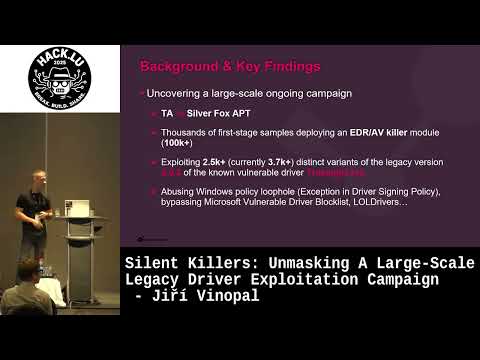
Traces a large-scale campaign that abused an old signed driver to terminate security products and deliver a RAT.

DragonJAR - Hacking y Seguridad Informática·4 min
Evaluates ransomware Rap and evaluates key implications for security practitioners.