Lowering the Orbit - Exploiting Proprietary Satellite Protocols via Software Defined Radio and GS
Where
Main Stage
DEF CON 34
Duration
25 min
Shows how an open-source, deliberately vulnerable CubeSat platform lets researchers practice radio attacks on CCSDS space packets.
Summary
Romel Marin opens with the gap that motivated the project. Space protocol documentation is easy to find, but there is no legal satellite to practice radio attacks against, and the number of active spacecraft keeps growing. He covers the basics a newcomer needs: a satellite as a computer in orbit, telemetry, telecommands and payload data, the link between space and ground segments, and the CCSDS standards with the Space Packet Protocol structure.
The core of the talk is PWNSAT, an open-source platform of intentionally vulnerable hardware. He describes its three versions, ending with a CubeSat built from a flight computer that runs Linux, a LoRa radio board and a power board, plus a plug-and-play ground station application. The demonstrations use a cheap RTL-SDR receiver to capture unencrypted downlink traffic and decode the packets. He then brute-forces application process identifiers over the Space Packet Protocol, much as directory scanning works against web applications, injects captured data back into the link, and fuzzes the firmware to trigger a denial of service.
The takeaway is that the downlink in these demos carries no cryptography, so anyone designing or assessing a space link should treat the radio path as an attack surface. He publishes the scripts, firmware, PCB designs and step-by-step walkthroughs on GitHub, along with about 34 documented vulnerabilities. He stresses that the tools are meant for lab hardware like his, not for real spacecraft.
Materials
Related talks
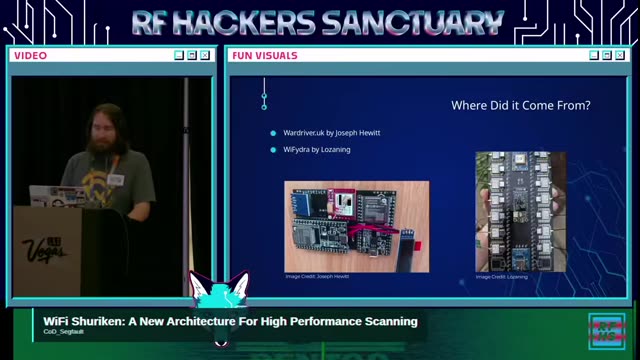
Radio Frequency Village·39 min
COD Segfalt
Presents the Wi-Fi Shuriken, a six-radio microcontroller scanner for wardriving that uses a shared binary bus and aggressive deduplication to collect more Wi-Fi networks per drive.

Main Stage·48 min
Nikos Vourdas · Kyprianos Vasilopoulos
Shows how an SMS gateway's trust assumptions and code bugs let attackers suppress, forge, and read one-time passcodes in transit.

Main Stage·43 min
Qiqing Huang
Shows how ASN.1-generated decoders in 5G phone basebands skip specification rules, so one altered byte can crash a modem before authentication.