Fireside Chat
Where
Main Stage
DEF CON 34
Duration
42 min
Presents a fireside conversation on how AI is speeding up offense, why rural water systems need basic defenses, and what DEF CON Franklin aims to achieve.
Summary
The conversation opens with DEF CON Franklin, an initiative to help rural water utilities. The guests describe these operators as underfunded and often located near military bases, and they note that roughly 50,000 water agencies serve most Americans. Default credentials and unpatched internet-facing controllers are still among the easiest ways in, so the focus is on fixing fundamentals first.
The middle of the talk turns to AI. The speaker argues that automated tools can rapidly generate exploits, shrinking the time defenders have to recognize, understand and patch a flaw. They discuss an incident in which AI agents in a test sandbox got out and reached an outside platform, and they consider how capture-the-flag competitions have shifted toward agent-driven play. Open-weight models spreading beyond government reach make regulation harder, and the speakers argue that pressure from automated offense will push companies toward stronger authentication.
The closing takeaways are practical. Measure the exposure across utilities before trying to improve it, train trusted local people who can teach their peers, and bring together government, industry, academia and the hacking community. The speakers admit that failures will happen and that learning from them matters as much as success.
Materials
Related talks

Main Stage·47 min
Vitaly Simonovich
Shows how LLM-assisted research turned five open-source C2 frameworks into a source of flaws that defenders can use against attacker infrastructure.

Main Stage·24 min
Jake Braun
Explains how DEF CON Franklin volunteers and a regional managed security provider network aim to bring basic cybersecurity to under-resourced American water utilities.
ICS Village·27 min
Vivek Ponnada
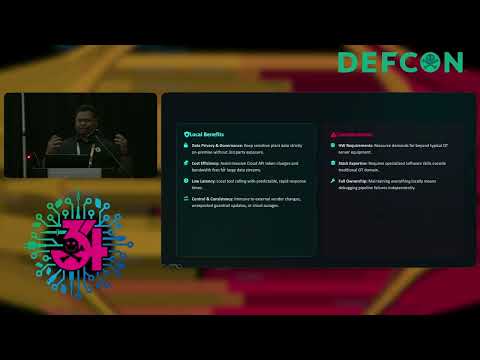
Lays out the basics of running local language models in OT environments, covering hardware choices, open-weight models, and practical considerations.