Defender’s Dilemma Releasing Dual-Use AI Models as Capabilities Climb
Where
Main Stage
DEF CON 34
Duration
1 hr 14 min
Panelists debate how to evaluate and release dual-use AI models, weighing open-weights diffusion and defender advantage as capabilities climb.
Summary
The panel opens by asking whether dual-use AI resembles earlier fights over encryption and export controls. Speakers argue that the central question is who decides which users get access, and they compare AI to telephones, cars and airplanes to show how different mental models lead to different levels of concern. A recurring theme is that friction, including limits on availability, built-in safeguards, legal consequences and defender action, has historically managed dual-use risk.
The middle section covers diffusion. Participants expect capable open-weight models to trail frontier systems by only months, helped by falling token costs and local hardware. They discuss whether coordinated disclosure still works when findings spread instantly, and they point to AI-assisted cryptanalysis and firmware diffing as examples of capabilities that already exist. Alignment, meaning whether a model recognizes when it is in the wrong situation, is raised as a gap in how capability is currently measured.
The closing segment looks at defense. Suggestions include intent-based access decisions, graduated verification instead of yes-or-no checks, audit frameworks that regulators can converge on, and treating integrity as a neglected security property. The practical advice is to press vendors to adopt AI-assisted defense now, prepare for a difficult stretch of roughly eighteen to twenty-four months, and keep contributing ideas to the community.
Materials
Related talks

AI Village·25 min
Jeff Crume
Compares the 1995 release of the SATAN network scanner with today's restricted AI vulnerability tools, arguing that limiting access hurts defenders more than attackers.
Policy Village·26 min
Carole House
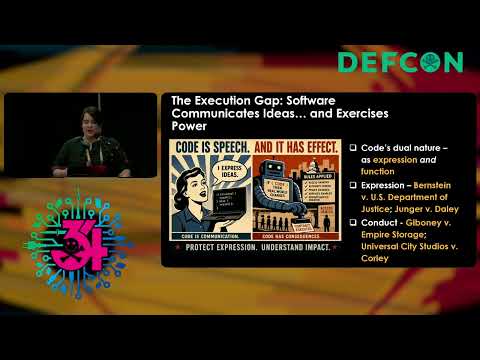
Maps the legal doctrine on who answers for code that acts, from AI agents to crypto protocols, and proposes a functional lens built on control and foreseeability.

Main Stage·47 min
Vitaly Simonovich
Shows how LLM-assisted research turned five open-source C2 frameworks into a source of flaws that defenders can use against attacker infrastructure.