Just DevOps 2019 - Jakub Hajek - Container orchestration with Docker Swarm
Analysts investigate attack surfaces and defenses concerning Just DevOps 2019 - Jakub Hajek - Container orchestration with Docker Swarm.
Summary
### Overview In this talk from Just DevOps 2019, Jakub Hajek discusses container orchestration using Docker Swarm as a practical, lightweight alternative to complex platforms like Kubernetes. Drawing from his background running projects and leading a DevOps/admin team at Sole Metal / Elastometal, Hajek argues that many teams rush into Kubernetes due to industry hype rather than actual architectural needs. Docker Swarm provides a low barrier to entry, out-of-the-box cluster management, and stable orchestration that fits many production workloads without unnecessary operational overhead.
### Key Topics - **Rationale for Docker Swarm**: Avoiding overengineering and excessive complexity; understanding core business needs and achieving faster delivery without the steep learning curves of Kubernetes or service meshes. - **Swarm Architecture & Consensus**: Node roles (Managers vs. Workers), Raft consensus algorithm for maintaining state, quorum requirements, and leader election. - **Declarative Services & Scheduling**: Defining desired states (replicas vs. global mode), placement constraints, placement preferences across availability zones/datacenters, and automatic reconciliation. - **Zero-Downtime Updates & Healthchecks**: Rolling updates with configurable parallelism, delay, healthchecks, and automatic rollbacks on failure. - **Networking, Discovery & Security**: Ingress routing mesh, internal service discovery via built-in DNS, encrypted overlay networks (IPsec), and native secrets/configs management. - **Edge Ingress with Traefik & Consul**: Dynamic routing, automatic SSL/TLS certificate generation and renewal via Let's Encrypt, and horizontally scaling ingress with Consul as a distributed key-value store.
### Technical Details - **Cluster Initialization & Management**: Initializing a single-node or multi-node cluster requires just `docker swarm init`, followed by `docker swarm join` using generated authentication tokens over mutually authenticated TLS (gRPC/HTTP2). - **Consensus & State**: The Raft database is stored on manager nodes at `/var/lib/docker/swarm/raft`. The leader coordinates log replication, while manager nodes maintain quorum and handle scheduling. Workers merely execute tasks and report statuses. - **Declarative Service Definition**: Services can run as replicated (0 to N tasks/containers) or `global` (exactly one container per node, useful for monitoring agents like cAdvisor or node exporters). Scheduling can be influenced by labels, resource constraints (CPU/RAM), or placement preferences across availability zones. - **Rolling Updates**: Configured via update parameters such as parallelism (e.g., updating 1 container at a time) and delay (e.g., 10s intervals), relying on healthchecks (HTTP response status 200 via curl or wget) to halt and roll back if tasks fail. - **Secrets and Configs**: `docker secret` stores sensitive data encrypted in Raft, mounted decrypted in-memory under `/run/secrets/<name>` for explicitly permitted services. `docker config` provides a non-encrypted equivalent, requiring versioning conventions (e.g., appending version numbers) when configurations change. - **Traefik and Consul Stack Demo**: Demonstrated on AWS `t2.micro` instances provisioned via Docker Machine across three VMs. Traefik listens on `/var/run/docker.sock` to detect Swarm service events automatically and dynamically update routes defined by Docker service labels. Consul acts as the shared key-value store for Let's Encrypt certificates, enabling multiple Traefik replicas to synchronize certificates without collision.
### Takeaways - Master Docker fundamentals (image optimization, 12-factor principles, environment configuration) before advancing to complex orchestrators. - Docker Swarm provides production-grade clustering, built-in ingress routing mesh, service discovery, secrets, and zero-downtime rolling updates out of the box with minimal maintenance. - Swarm serves as an ideal baseline for projects requiring stability and simple operational overhead, with the option to migrate to Kubernetes later if complex features become strictly necessary.
Related talks
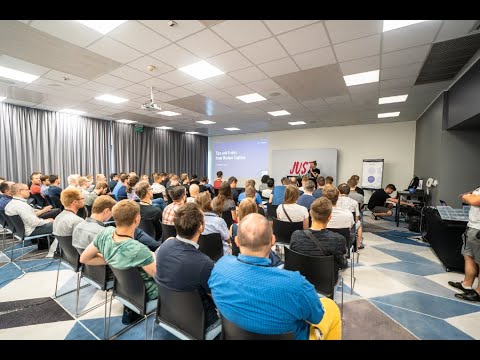
PROIDEA Events·35 min
Łukasz Lach
Engineers explore architecture and security mechanisms for Just DevOps 2019 - Łukasz Lach - Tips and Tricks From Docker Captain.

PROIDEA Events·55 min
Atmosphere Shuttle #02 Wrocław
Atmosphere Shuttle #02 Wrocław analyzes Docker & Devops - Maciej Lasyk.

PROIDEA Events·36 min
Analysts investigate attack surfaces and defenses concerning 4Dev Live 2021: Jakub Waliszewski - Azure DevOps in a secured World. How to build a safe Pipelines!.