Information Hiding in Executable Binaries
Rakan El-Khalil explores information hiding in executable binaries at DEF CON 12, examining malware-analysis and practical defenses.
Summary
Architecture and Background
Rakan El-Khalil, Information Hiding in Executable Binaries Information Hiding techniques are much researched in the context of watermarking or fingerprinting images and sound files, mainly as a means of copyright protection and piracy prevention/detection. Those mediums offer a significant amount of redundancy, thus lending themselves to the implementation of robust IH systems. Executables however do not offer such amounts of redundancy, and have thus far proven to be a difficult and rarely used medium for steganographic and other IH purposes.
Vulnerability Analysis
The aim of this talk is to be an introduction to IH, with a thorough coverage of state of the art techniques for embedding into binaries. Hydan, a tool for performing such embeddings in machine code, will be presented. In addition to typical IH uses [steganography, watermarking], the tool and techniques shown can be used in anti-reverse engineering, trusted application execution, frustrate some buffer overflow attacks, and as an engine for metamorphic viruses.
Exploitation and Demonstrations
An interesting effect of the tool is that the executable remains the same size before and after embedding, while of course remaining functionally equivalent. Rakan El-Khalil is currently on sabbatical in France. He is a recent MS CS graduate from Columbia University.
Remediation and Defensive Strategies
While he was there he worked on a variety of projects at the CS Research Lab, such as an IDS that uses machine-learned models to detect network threats, and a syscall based permission system on OpenBSD [predating systrace]. He was also responsible for the short-lived official KaZaA Linux client `kza". Currently he is involved with The Bastard, a powerful linux disassembler, and has been researching steganography and information hiding in machine code.
Related talks

Main Stage·13 min
Sean O'Toole
Sean O'Toole explores mutating the mutators at DEF CON 12, examining malware-analysis and practical defenses.
Main Stage·39 min
Agostino Panico
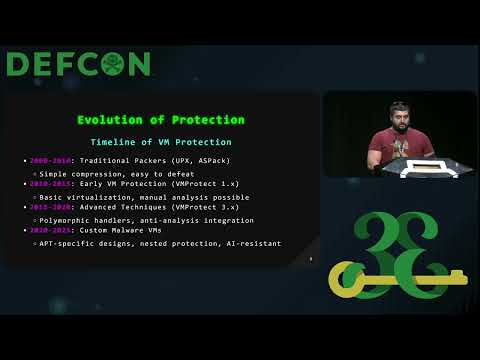
Presents a dynamic analysis framework for automatically unpacking and deobfuscating nested virtual-machine-based software protectors used in advanced malware.

Main Stage·21 min
Patrick Wardle
Patrick Wardle presents specialized reverse engineering techniques and tooling to automatically extract obfuscated AppleScript and shell payloads from macOS malware.