How to Secure Unique Ecosystem Shipping 1 Billion+ Cores?
Details the security architecture and defensive engineering required to secure NVIDIA's transition of the Falcon microprocessor to RISC-V across billions of GPU cores.
Summary
Scaling Security Across Billion-Core Architectures
NVIDIA's proprietary microprocessors control GPU hardware initialization, power management, and secure enclave isolation across billions of deployed chips worldwide.
Transitioning Falcon to RISC-V Architecture
Adam Zabrocki and Marko Mitic detail NVIDIA’s multi-year engineering initiative transitioning internal Falcon microcontrollers to a hardened RISC-V architecture deployed at massive scale.
Hardware-Enforced Security and Cryptographic Boot
Securing custom silicon architectures requires hardware-enforced memory isolation, cryptographic boot verification, and real-time execution monitoring inside GPU firmware.
Lessons for Custom Silicon Security
Engineering custom processor architectures at planetary scale requires integrating automated formal verification, hardware fuzzing, and resilient firmware update mechanisms.
Related talks
Main Stage·33 min
Anthony Rose · Jake Krasnov
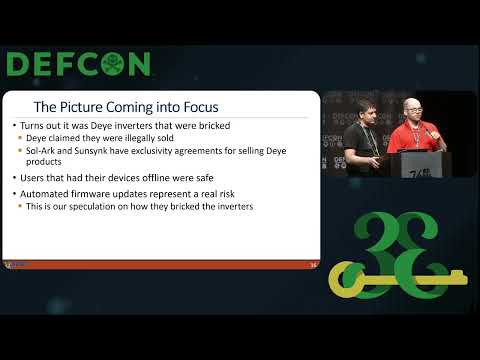
Uncovers widespread firmware backdoors and hardware vulnerabilities in commercial solar inverters and energy management gateways across global supply chains.

Main Stage·43 min
Yaniv Balmas · Lior Oppenheim
Yaniv Balmas and Lior Oppenheim demonstrate reverse engineering KVM switch firmware, subverting the 8051 microcontroller to install an undetectable, persistent hardware keylogger.

Creator Stage·21 min
Larry Pesce
Demonstrates hardware disassembly, SPI flash extraction, and JTAG interfacing to build an accurate Software Bill of Materials for an IoT Wi-Fi router.