How Do MRI Machines Work? An Introduction to MRI and Open Source Imaging
Where
Talks
A New HOPE
Duration
54 min
Explains the physics and hardware behind MRI scanners, from magnets and RF coils to image reconstruction, with open-source imaging projects.
Summary
Douglas Brantner, an MRI research engineer who works on motion sensors and test objects, gives a broad introduction to how magnetic resonance imaging machines function. He starts with the practical problems: patient motion degrades scans, metal and conductive parts are hazardous near the magnet, and scanners are expensive and hard to access. He also contrasts MRI with CT, noting that MRI uses no ionizing radiation, and surveys clinical uses such as functional imaging and contrast selection.
The middle of the talk walks through the physics. Hydrogen protons align with a strong static field and precess, and a radio frequency pulse tips them and brings them into phase. The resulting signal decays with T1 and T2 relaxation, and gradient coils shift the resonance frequency with position so the signal can be localized. Data is collected in k-space and converted to an image with an inverse Fourier transform. Brantner also covers superconducting magnets, cryogenic cooling, shim coils, and the Faraday cage around the scanner room.
Brantner then describes his own sensor work: testing non-magnetic components, measuring RF noise and field homogeneity with phantoms, and shielding a motor-driven motion phantom. He closes by presenting the Open Source Imaging project, which builds lower-cost and tabletop scanners and invites collaborators. The main takeaway is that MRI is a demanding, safety-critical engineering problem, and that open hardware efforts are trying to make it more accessible.
Related talks
Talks·53 min
Danny Chan
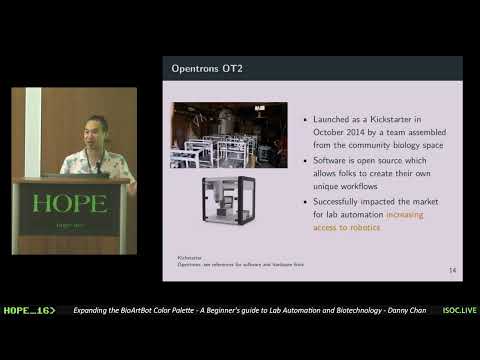
Shows how an open-source pipetting robot paints pixel art with colored bacteria, and how new pigments were found and checked.

Talks·57 min
Mixæl S. Laufer
Shows open-source tools for automated chemical synthesis, a DIY defibrillator build, and home-made emergency medicine kits.

Biohacking Village·31 min
Sam Cervantes
Presents an open-source hardware and software telemetry platform designed to monitor emergency hospital ventilators remotely.