Grand Theft Actions: Abusing Self-Hosted GitHub Runners
Exploiting insecure defaults in self-hosted GitHub Actions runners to compromise repositories, cloud environments, and internal networks.
Summary
Insecure Defaults in GitHub Actions CI/CD
GitHub Actions is quickly becoming the de facto CI/CD provider for open-source projects, startups, and enterprises. At the same time, GitHub’s security model is full of insecure defaults. This makes it easy for their customers to expose themselves to critical attacks from the public internet. The end result? A systemic vulnerability class that won’t go away.
Abusing Self Hosted Runners from Public Repositories
During our research, we identified GitHub Actions misconfigurations at scale that would allow threat actors to backdoor major open-source projects. An example of this is our attack on PyTorch, a prominent ML framework used by companies and researchers around the world.
Lateral Movement into Enterprise Cloud Infrastructure
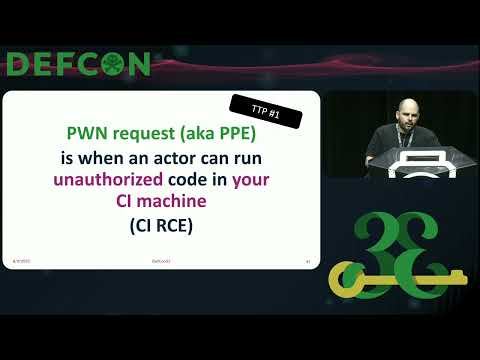
Through this attack, we could contribute code directly to the main branch of the PyTorch repository, upload malicious releases, backdoor other PyTorch projects, and more. These attacks began by compromising self-hosted runners, which are machines that execute jobs in a GitHub Actions workflow. From there, we leveraged misconfigurations and GitHub “features” to elevate our privileges within GitHub Actions workflows.
Our research campaign included dozens of reports, over $250,000 in bug bounties, and endless war stories. Tune in for a deep dive into the TTPs that allow turning a trivial runner compromise into a full supply chain attack.
Related talks
Main Stage·42 min
Aviad Hahami
Reconstructs the multi-stage CI/CD supply chain compromise of the popular tj-actions GitHub Action, detailing secret exfiltration and attacker tradecraft.

Main Stage·40 min
Asi Greenholts
Asi Greenholts demonstrates a proof-of-concept worm propagating through the GitHub Actions ecosystem by compromising interdependent custom actions.

App Sec Village·26 min
Elad Pticha · Oreen Livni
Demonstrates a command injection vulnerability in the Bazel GitHub Action that allowed malicious tampering in Google's build pipeline.