From 0 To Millions: Protecting Against AitM Phishing At Scale
Where
Talks
hack.lu 2024
Duration
33 min
Shows how a free token flags adversary-in-the-middle phishing against Microsoft Entra ID logins before passwords are entered.
Summary
The speaker opens with the growth of a free detection token that watches Microsoft Entra ID login pages for adversary-in-the-middle phishing. Reverse-proxy phishing kits relay the real login, so most MFA prompts can be passed through and the resulting session stolen. The core problem is a visibility gap: when identity is outsourced to a vendor, the tenant owner sees little telemetry until after authentication has already happened.
The sensor is a small CSS snippet added to the customized login page. It makes the browser fetch a one-pixel image hosted on AWS CloudFront, and the request's referrer is checked against Microsoft's domains. A missing or mismatched referrer raises an alert, which can reach the tenant owner with the source address and user agent before the victim types a password. Owners can then revoke sessions or push the alert to a webhook. The speaker walked through a live demo using an open-source phishing kit.
Deployment data showed that most phishing domains appear for a single day against one tenant, while a smaller persistent group lasts much longer. Cross-tenant reuse has grown to about 40 percent of observed domains, and many attacker certificates were issued the same day. Multi-day, cross-tenant domains are now shared through MISP at TLP:CLEAR. Caveats include referrer spoofing, a Chromium bug that ignores a referrer-suppression header, and security scanners triggering alerts. The main lesson is that outsourcing identity reduces detection visibility, and phishing-resistant credentials are the lasting fix.
Related talks
Talks·24 min
Peter Manev · Eric Leblond
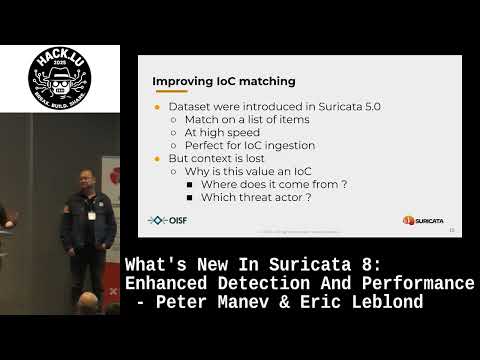
Covers Suricata 8's new detection keywords, transactional rules, IOC context matching and firewall mode.

Talks·48 min
Tess Mishoe
Surveys modern RDP attacks against MFA-enabled systems and shows how spray and fatigue patterns appear in authentication logs.

Talks·49 min
John Stoner
Shows how the GraphRunner toolkit maps to Entra ID and Office 365 attack stages and the logs that reveal them.