Cyber Defenders - Turning Skills Into Lifesaving Action
Where
Talks
CactusCon 14
Duration
23 min
Explains how security skills can help nonprofits, OSINT teams, and families protect children and older adults from online harm.
Summary
Kristen Sanders opens by placing the hacker community's history of pushing for positive change, from internet freedom and anti-censorship work to responsible disclosure, alongside today's threats. She focuses on harms to children and older adults, including sextortion, cyberstalking, AI-enabled impersonation, and extremist networks that pressure minors toward self-harm.
The middle section covers practical ways to help. Nonprofits that work with law enforcement often lack strong security for sensitive victim data, so donated security, development, cloud, and hosting skills matter. For OSINT practitioners, she describes Trace Labs as a more accessible route into missing-person work, contrasted with a more demanding, vetted group focused on victim identification. At home, she advises delaying phones and social media, limiting public sharing, watching for chats that move to other apps, and talking openly about deepfakes and cloned voices. For older relatives, she recommends empathy, open-ended questions, and admitting one's own worries instead of punishing a mistake, with negotiation and body-language material as useful training.
She closes with reporting resources: a child-focused reporting line, a service that removes images of minors online, age-appropriate education material for kids, and the FBI's IC3 for elder fraud, which she notes has little public content. She asks attendees to donate skills, teach elder-fraud classes at senior centers, and push schools for online safety curriculum.
Related talks

Talks·57 min
Jack Gangi
Traces the decline of hacker third spaces and suggests practical ways to rebuild in-person community.
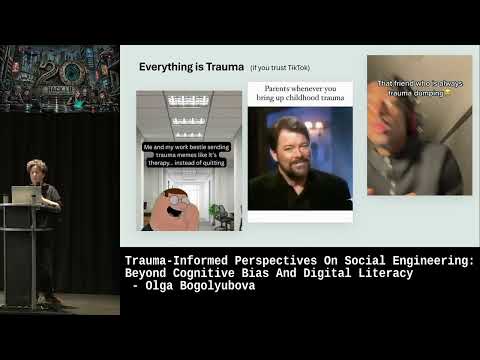
Talks·28 min
Olga Bogolyubova
Argues that trauma and attachment research can explain social engineering vulnerability better than cognitive bias models.

Talks
Examines how AI is accelerating mass surveillance and what that means for cybersecurity.