CHERI: A Modern Capability Architecture
Where
Talks
A New HOPE
Duration
48 min
Explains how CHERI adds hardware capabilities to processors to enforce fine-grained memory protection without relying on secrets.
Summary
The talk opens with the argument that memory safety bugs such as buffer overflows and use-after-free still account for most serious software vulnerabilities, decades after the problem was first widely understood. Using a short C program on a RISC-V target, the speaker shows how a processor that treats pointers as plain addresses cannot notice an out-of-bounds write, so corruption spreads silently until the program fails far from the original bug.
The core of the talk explains CHERI, an extension to existing instruction sets that turns pointers into hardware capabilities carrying an address, bounds, and permissions. Memory keeps a hidden validity tag for each 16-byte granule, and any operation that tampers with a capability clears its tag, so the processor traps instead of silently corrupting state. The speaker covers how compilers, the loader, and the kernel adapt, how ported software such as FreeBSD and much of KDE needed little change, and how sealed capabilities support compartmentalization and cheap communication within one address space. Temporal safety is addressed with quarantine and revocation sweeps, and performance results from the research hardware are reported.
In closing, the speaker argues that capabilities complement safe languages such as Rust, since a sandbox around unsafe code can turn hardware traps into recoverable errors for the safe side. Arm's Morello prototype shows the design running on real silicon, though it is an experimental platform rather than a product. The Q&A covered speculative execution, where capabilities reduce some attacks but do not stop side-channel leaks of ordinary data.
Related talks
Talks·53 min
Danny Chan
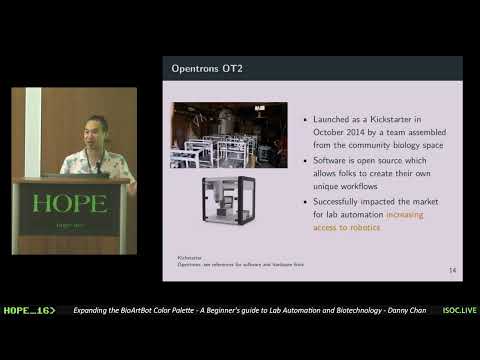
Shows how an open-source pipetting robot paints pixel art with colored bacteria, and how new pigments were found and checked.

Talks·37 min
Wesley Appler
Follows one hobbyist's effort to design an open source phone with privacy and intentional disconnection in mind.

Talks·47 min
Michael Ossmann
Walks through open-source FPGA tools for building USB devices, analyzing USB traffic, and emulating hardware.