Automated Malware Similarity Analysis
Daniel Raygoza explores automated malware similarity analysis at DEF CON 17, examining wireless-security and practical defenses.
Summary
Architecture and Background
Automated Malware Similarity Analysis Daniel Raygoza DC3 / General Dynamics While it is fairly straightforward for a malware analyst to compare two pieces of malware for code reuse, it is not a simple task to scale to thousands of pieces of code.
Vulnerability Analysis
Many existing automated approaches focus on runtime analysis and critical trait extraction through signatures, but they don't focus on code reuse.
Exploitation and Demonstrations
Automated code reuse detection can help malware analysts quickly identify previously analyzed code, develop links between malware and its authors, and triage large volumes of incoming data.
Remediation and Defensive Strategies
Daniel Raygoza is employed with General Dynamics at the Department of Defense Cyber Crime Center (DC3) Computer Forensics Laboratory (DCFL) as a Forensic Examiner, where he has worked for six years. He performs system forensics, incident response, malware analysis and reverse engineering, and R&D in support of his fellow analysts. He has presented several times at the DC3 Cyber Crime Conference, and has released several small tools for use by the forensics community. For copies of the slides and additional materials please see the DEF CON 17 Archive here:
Related talks

Main Stage·58 min
Zulu Meet
Zulu Meet details pLA Information Warfare Development Timeline and Nodal Analysis TK234 Analyst The development timeline is consistent with the broad contours of China's current IW theory.
Main Stage·43 min
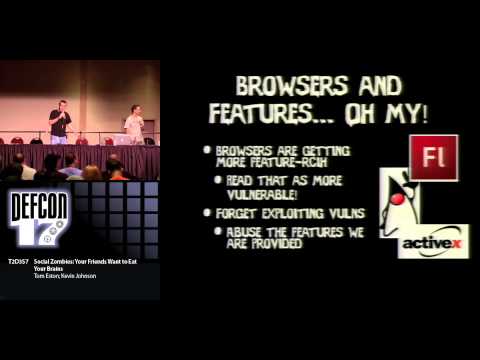
Tom Eston · Kevin Johnson
Tom Eston and Kevin Johnson explores social zombies your friends want to eat your brains at DEF CON 17, examining wireless-security and practical defenses.

Main Stage·43 min
Thomas Wilhelm
Thomas Wilhelm details hacking WITH the iPod Touch Thomas Wilhelm Sr.