ARTificial Intelligence - How IP Law Handles Machine Creations
Where
Talks
A New HOPE
Duration
56 min
Explains whether machine-generated output can qualify for patent inventorship or copyright under current intellectual property law.
Summary
The talk starts by defining the systems in question: large machine learning models, usually deep neural networks, trained on big datasets. The speaker treats such a network as a function that maps inputs to outputs, and argues that the real difference from ordinary software lies in how it is built. He then points to generative examples such as DALL-E images and Google's LaMDA writing a short fable as the outputs that raise intellectual property questions.
The main question is whether those outputs can earn copyright or patent protection. For copyright, protection requires human authorship and a modicum of creativity, and bare ideas are not protected. He reviews Stephen Thaler's cases, including a rejected copyright filing for a creativity machine and a patent application naming an AI as inventor that has reached the Federal Circuit. For patents, inventorship depends on conception, which he finds hard to attribute to a machine, and he compares unfiltered model output to the infinite monkey thought experiment.
He concludes that DALL-E output is probably not copyrightable and that the person writing the prompt would not own it, though a human who curates or arranges outputs creatively may have a stronger claim. He flags open issues such as whether training on copyrighted material is fair use. Questions from the audience covered standing, drug discovery, and code generation licensing. The takeaway is that the law remains unsettled and human contribution is the factor to watch.
Related talks
Talks·28 min
Aaron Kaplan
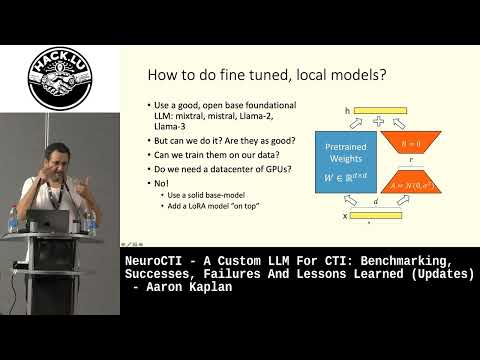
Shows how a local language model is fine-tuned for threat intelligence, covering benchmarks, data gaps and MISP integration.

Talks·22 min
Shing-Li Hung
Shows how dark web leak posts can be classified with BERT and turned into MISP-ready CTI reports using a local RAG setup.

Talks·4 min
S. Mokkadem · A. Iklody · A. Kaplan
Shows how a MISP module sends threat reports to an LLM and returns structured indicators for human review.