AI: A Gradient Descent Into Humanity's Doldrums - Hope Comes From the Hackers
Where
Talks
HOPE XV
Duration
38 min
Critiques how generative AI is trained and sold, and argues hacker ethics offers a way past degraded technology.
Summary
The talk opens by questioning two common stories about generative AI, one of machines surpassing humans and one of effortless abundance, and suggests both serve corporate and political interests. The speaker then walks through the basics of model training, including data, error measures and gradient descent. An airport screening example shows how optimizing for accuracy alone can push a model toward a trivial shortcut, such as labeling every case as normal to score high accuracy.
The middle section turns to language models, which predict the next token and are then tuned with human feedback. The speaker argues that the people grading responses shape what counts as acceptable output. Adversarial examples are presented as evidence that models rely on brittle features humans cannot perceive, which the speaker links to hallucinations. Training on synthetic output is described as a route to model collapse, and commercial hype is criticized for weak economic returns, with code generation offered as a field where small errors compound.
The closing part draws on cultural and historical arguments, including principles for data sovereignty and the view that research depends on open sharing and peer scrutiny. Using a 2001 book on the hacker ethic, the speaker proposes passion, openness, caring and creativity as values for judging how AI should be used. The practical takeaway is to treat models as tools rather than replacements for the slow, failure-driven work of building understanding.
Related talks

Talks·46 min
JJ Asghar
Explains why open AI models matter and walks through running and fine-tuning IBM's Granite model locally.
Talks·34 min
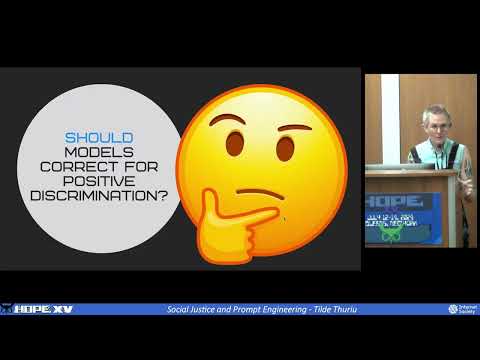
Tilde Thurium
Surveys research on how prompt wording shapes bias in LLM outputs and text-to-image models, with practical mitigation ideas.

Talks·46 min
Aisling Fae
Explores how animist beliefs about souls in objects can inform ethical thinking about computers and AI systems.