A visual journey to reverse-engineering the Enigma Machine - preventing MITM
Where
Talks
LASCON 2023
Duration
48 min
Traces how the Enigma machine's rotors, reflector and plugboard worked, then rebuilds it with serverless functions.
Summary
The talk opens with a tour of early substitution ciphers, from the reversed-alphabet Atbash and Caesar shifts to tap code and Morse, and explains why frequency analysis could break them. It then presents the Enigma machine as a commercial answer to that weakness, developed after the First World War to protect messages from interception before military forces adopted it.
The middle section takes the machine apart. It covers the keyboard and lamp board, three rotors that step like an odometer after each keypress, a reflector that lets the same settings both encrypt and decrypt, and a plugboard on military models. Using a simplified rotor diagram, the speaker shows how the signal path changes with each press and estimates the size of the configuration space. Daily settings were distributed in code books, and the initial setting was sent twice to catch errors.
To finish, the speaker rebuilds the machine as a state machine, with one serverless function per component, a workflow service ordering the steps, an API and a small web interface. A live demo with audience-chosen settings encrypts a short word, and changing a single setting turns the output into unreadable text. The session closes with code for the lookup logic and a Q&A on why code books were harder to capture than the machines themselves, and on how codebreakers exploited the fact that a letter could never encode to itself.
Related talks
Talks·49 min
Elonka Dunin · A.J. Jacobs
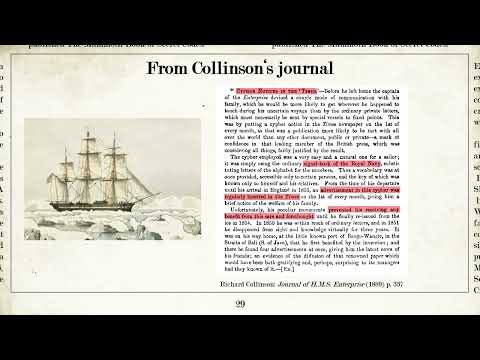
Traces 19th century encrypted newspaper ads through their history and shows how classic ciphers can be broken with free tools.

Main Stage·44 min
Elonka Dunin · Klaus Schmeh
Decryption and historical investigation of Victorian-era encrypted personal advertisements published in The Times of London.

Main Track 1·44 min
Matt Joyce
Using digital forensics techniques to recover history and data from vintage hardware artifacts.