A Revolution in Representation: Computation Comes to Democracy's Aid
Where
Talks
HOPE XV
Duration
56 min
Shows how the open-source Polis deliberation system helps groups find shared ground and how governments and movements use it.
Summary
The talk opens with a recap of a workshop on group decision-making and governance held the night before, then traces the speaker's background in participatory projects. These ranged from street-level listening experiments and open-science work to the 2014 protests in Taiwan and the civic technologists who followed. It introduces Polis, an AGPL-licensed deliberation system created in 2012, which presents participants with short statements they can agree with, disagree with or pass on, and then maps the resulting opinion groups.
The middle of the talk covers case studies at national and local scale. These include Taiwan's V Taiwan process, a climate assembly in Austria, a ballot-related deliberation in Uruguay, a Slovak civil society effort to counter misinformation, a UK government policy lab, and a multinational youth consultation tied to a UN climate summit. The speaker explains the comment routing that decides which statements each person sees, how consensus statements and bridging across clusters are read, and why outreach, framing and moderation matter as much as the software itself.
The closing section takes audience questions on censorship, identity checks, reaching rural and marginalised communities, and whether results can carry binding power. The speaker argues that tools placed between citizens and their governments should be open source so that independent oversight remains possible. Practitioners are encouraged to consider how the tools they already build could support collective decisions.
Related talks

Talks·42 min
Sabar Dasgupta
Presents an open framework that packages research data, code and figures in containers for reproducible, archived science.
Policy Village·26 min
Carole House
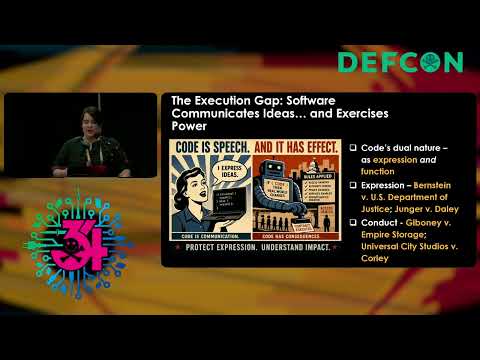
Maps the legal doctrine on who answers for code that acts, from AI agents to crypto protocols, and proposes a functional lens built on control and foreseeability.

Talks·27 min
Ross Bailey
Shows how cheap, off-the-shelf AI tools can clone faces and voices, and why that undermines everyday trust.