A Realistic Implementation
Where
Talks
hack.lu 2024
Duration
31 min
Shows how a team turns vendor-neutral Sigma detection rules into SIEM queries through a git-based pipeline.
Summary
The speaker, who works in incident response and detection, opens by explaining that Sigma is a generic YAML format for detection rules that can be shared and converted into queries for different SIEM and EDR platforms. Converting rules has become more practical with pySigma, which introduced backends that act as platform drivers and pipelines that map rules onto a specific environment's log sources and field names. The core problem raised is that stock Sigma rules often do not match real endpoint and SIEM data, and that maintaining rules by hand across many customer environments does not scale.
The middle of the talk covers the team's approach. Detection content lives in a git repository and is handled as code through a CI/CD workflow. Each change is validated against the Sigma specification, converted with Droid, a wrapper built on pySigma, and searched against existing datasets to surface false positives before export. Per-rule filters document accepted exclusions, a multi-tenant mode lets the same workflow reach several customer tenants, and a later integrity check compares deployed rules with the converted output. Branches move from feature to develop to main, which adds review at each stage. Unit testing with Atomic Red Team was described as work in progress.
The main takeaway is that detection logic can stay vendor-neutral, so changing a SIEM or EDR mainly means changing conversion settings rather than rewriting hundreds of rules. The speaker noted that the tool is open source and that correlation handling and more platforms remain open work. In the Q&A, run times were said to vary by platform because of API rate limits, and filtered alerts are still logged so analysts can revisit them later.
Related talks

Ground Floor·25 min
Neerja Sonawane · Kiran Shirali
Shows how eBay replaced a costly third-party SIEM with open-source Kafka, Flink and Hadoop for near real-time detection.

Ground Floor·47 min
Zach Wasserman
Shows how to manage detection rules as code in Git using osquery, Fleet, and Matano with reviewed pull requests.
Talks·24 min
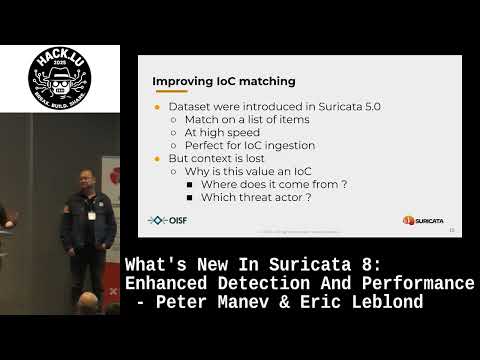
Peter Manev · Eric Leblond
Covers Suricata 8's new detection keywords, transactional rules, IOC context matching and firewall mode.