AI Village·14 min
Aditi Narasimhan · Farzaan Kaiyom
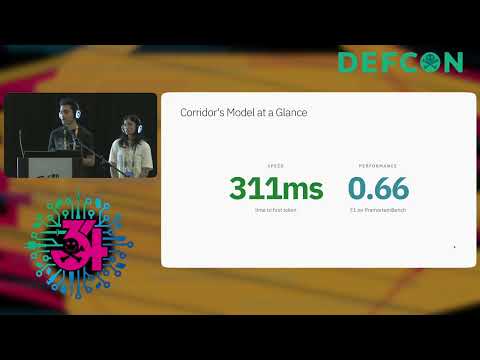
Shows how a pre-implementation security context step and a small fine-tuned model can make coding agents produce more secure code.
aiappsecframework+2
DEF CON 34 talks are here: 354 talks, summarized and searchable.
Browse DEF CON 34DEF CON 34/AI Village across years
Las Vegas Convention Center · 6–9 August 2026 · 9 talks
AI Village talks from DEF CON 34.
1–9 of 9 talks
AI Village·14 min
Aditi Narasimhan · Farzaan Kaiyom
Shows how a pre-implementation security context step and a small fine-tuned model can make coding agents produce more secure code.
AI Village·31 min
Shows how large language models can map medical device policies to HIPAA and NIST guidance, and how prompt injection puts clinical IoT systems at risk.
AI Village·30 min
Curt Bernard
Explains how Anthropic sorts cybersecurity requests into four risk categories and why its Fable 5 safety margin blocks more defensive work.
AI Village·30 min
Stav Cohen
Shows how agentic browsers such as Atlas, Comet, Claude in Chrome and Gemini can be hijacked through poisoned pages, calendar invites and browser history.
AI Village·24 min
Julie Brunias
Introduces an eight-class taxonomy of agentic AI security failures and a refusal-filtered harness showing that the orchestration framework shifts compromise rates.
AI Village·25 min
Krity Kharbanda · Emma Fang
Shows why Zero Trust controls miss compromised AI agents, since prompt injection hijacks intent after authentication passes and the logs stay clean.
AI Village·49 min
Thomas Mason · Tahseen Rabbani
Shows how Google's SynthID image watermark can be stripped with light diffusion regeneration and a fast offline surrogate detector trained on paired images.
AI Village·25 min
Tobias Diehl
Shows how indirect prompt injection in Microsoft Copilot can turn document conversions, shared sessions and device code phishing into trusted attack paths, and introduces the Locusta toolkit.
AI Village·25 min
Jeff Crume
Compares the 1995 release of the SATAN network scanner with today's restricted AI vulnerability tools, arguing that limiting access hurts defenders more than attackers.